AI in education news in November 2026 is a story of schools and universities trying to catch up with their students. This hub covers the latest AI education news, from academic integrity and AI detection to school policy, teacher training and higher education, with every development dated and sourced as of 23 November 2026.
The numbers explain the urgency. In written evidence to the UK Parliament, techUK reported that more than two thirds of 13 to 18-year-olds said they used AI, with 61 percent using it for homework, and that 94 percent of higher education students said they used AI for assessment. The question is no longer whether students use AI, but how assessment, teaching and policy adapt to it.
For the wider industry picture, see our AI industry news hub.

AI in Education News Today: November 2026 at a Glance
The week of 11 to 17 November 2026 brought a cluster of education AI stories. The UK Department for Education opened a consultation on a voluntary safety certification for AI and EdTech products used in schools, colleges and nurseries in England. The California Federation of Teachers asked Governor Gavin Newsom to order a three-year pause on AI use in public school classrooms from kindergarten through eighth grade. Ohio State University reported 816 academic misconduct cases involving unauthorised AI use in 2025 to 2026, up from four in 2023.
On 19 November 2026 the EU Council adopted conclusions calling on member states to adapt education and vocational training to AI, develop AI competences from school age, train teachers and review assessment methods. On 10 November 2026 the UK House of Commons Education Committee heard evidence on AI in further and higher education, with warnings that exam rules and teaching methods need to catch up with how students actually use the technology.
Academic Integrity AI News: Cheating, Detection and the Numbers
Academic integrity AI news in November 2026 is dominated by a single statistic. Ohio State University’s 2025 to 2026 academic misconduct report recorded 816 cases involving unauthorised AI use, up from four in 2023. They made up 19 percent of all misconduct cases at the university.
The pattern is not confined to one campus. A high school in Seoul’s Yangcheon District ordered about 240 students to retake a Korean language and writing assessment after an AI detection program flagged around 170 submissions, and more than 10 students admitted using AI. The top scorer on South Korea’s tax accountant exam admitted cheating, saying he photographed questions with a hidden device.
Academic integrity AI detection news today carries a warning of its own. Detection tools are often unreliable and can flag genuine work as machine generated. In the UK Parliament evidence, techUK noted that fear of being accused of cheating is a key factor holding students back, and argued that assessment must evolve to capture not only end products but learners’ reasoning, application and problem-solving processes, pointing to greater use of practical tasks, vivas and collaborative projects.
That shift in assessment is now the central debate. If AI can produce an essay or a piece of coursework, a university needs to show that a degree still certifies what a graduate can actually do. The EU Council’s November 2026 conclusions make the same point: a finished product does not necessarily demonstrate that a student has acquired the knowledge or skills being assessed, so assessment practices need to be reviewed.
AI in Schools News: Policy, Pauses and Safety Certification
AI in schools news in November 2026 shows policy pulling in different directions. The California Federation of Teachers asked Governor Gavin Newsom to order a three-year pause on AI use in California public school classrooms from kindergarten through eighth grade, citing student safety, data protection, teacher readiness and the effects of AI on learning. California is also developing statewide AI guidance and a model policy under Senate Bill 1288.
In England, the Department for Education is consulting on a voluntary certification scheme for AI and EdTech products used in English schools, colleges and nurseries, with responses due by 4 February 2027. The scheme would give schools a safety signal when choosing products, rather than leaving each school to judge a vendor’s claims alone.
Other districts are making narrower decisions. Baltimore County Public Schools will no longer require the Amira AI reading platform for kindergarten through third grade. A planned Alpha School pilot at Kiley Prep in Springfield, Massachusetts, did not launch after a cyberattack, unresolved data agreements and questions over parent notice and student privacy. The Portland Public Schools policy committee reviewed the district’s generative AI systems and recommendations on AI literacy, data privacy and responsible use.
The Chicago picture shows the data question in sharp focus. Parents, students and teachers planned a rally outside Google’s office, saying AI features remain in Chicago Public Schools student accounts and raising concerns that school data could be shared with AI companies. New York City Council Speaker Julie Menin and Council Member Shekar Krishnan asked Google CEO Sundar Pichai to clarify whether schools could lose Search access if they reject student AI tools.

Google’s New AI Rules for Schools
Google’s November 2026 education updates will give school administrators greater control over student access to Gemini and Google Search, while introducing Guided Learning features that encourage students to work through academic problems rather than immediately receiving answers.
On 3 November 2026 Google announced significant changes to its AI tools for K-12 education, introducing new school-level controls and expanding Guided Learning across its education products. Under the upcoming changes, Google will turn off access to several services for K-12 student accounts unless school administrators explicitly enable them. These services include Gemini, Gemini Notebook, Gemini in Google Classroom and Google Search. School administrators can decide which services students can access, with options that may vary by grade level.
One part of the announcement drew criticism. Schools will not have the option to enable a traditional Google Search experience while independently turning off its integrated AI features. According to Education Week’s reporting, schools that want students to retain access to Google Search must also accept the AI functionality built into the search experience. Google has said it will provide schools with more implementation details before the new controls roll out, with the changes expected to begin in 2027, while some Guided Learning features are already becoming available.
For high school students and parents, the change highlights a distinction that runs through this whole hub: using AI to finish assignments more quickly is not the same as using it to become a more capable, independent learner.
Higher Education AI News: Universities Rethink Degrees
Higher education AI news in November 2026 centres on what a degree certifies. The UK Education Committee’s second evidence session on 10 November 2026 turned to higher education, with evidence from the Higher Education Policy Institute, Jisc, the National Union of Students and King’s College London. MPs raised the impact of AI on research, academic integrity, university staff and the value employers place on degrees.
The committee is investigating how AI is reshaping learning, including its effect on critical thinking, problem solving and speaking skills, the risk that it deepens inequality between students, and whether students and staff are being supported to use it safely and responsibly. Colleges warned about jobs and assessment in the first session, with witnesses from City of Portsmouth College, the University and College Union, the Association of Employment and Learning Providers and the Association of Colleges.
AI in higher education news for 2026 also covers the practical side: universities writing AI policies for coursework, training staff to design assessments that AI cannot complete alone, and deciding what to do when a detection tool flags a student’s work. The direction of travel is away from detection as the main defence and towards assessment that asks students to show their reasoning, in a viva, a practical task or a collaborative project.
EdTech AI News: Tools, Training and the Teacher Question
EdTech AI news in November 2026 covers the products schools are actually buying, and the training teachers need to use them well. Teacher AI news in 2026 includes workload tools that draft lesson plans, mark routine work and summarise student progress, and the concern that teachers are coping with the pace of change without enough time or training.
Teacher training AI news is now a policy priority. The EU Council’s conclusions call for support to develop AI literacy during both initial professional preparation and continuing development, and encourage peer-learning networks and communities of practice so schools can compare experiences and improve training. The Council also stresses the continuing importance of foundational skills: literacy, mathematics and science remain essential for developing digital and AI-related competences.
Education technology AI news also includes the EU-OECD framework presented in June 2026, which identifies 19 AI competences for primary and secondary education and can support adaptations to national curricula. The Council’s conclusions establish political guidance for cooperation and national policymaking, but they do not introduce a new compulsory school subject across Europe.
For teachers looking for classroom tools, see our guide to AI tools for teachers.
AI in Education Trends 2026: What the Evidence Shows
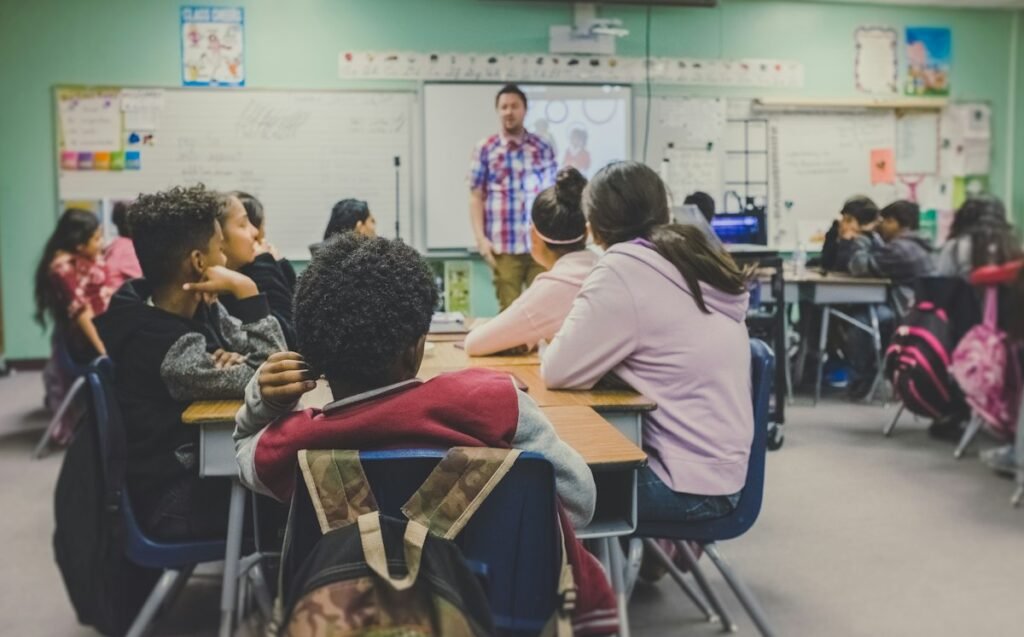
AI in education trends for 2026 point in one direction: use is near universal among students, policy is fragmented, and assessment is the battleground. The techUK evidence puts numbers on the first point, with more than two thirds of 13 to 18-year-olds using AI and 94 percent of higher education students using it for assessment. The California pause request and the UK certification consultation show the second point, with different jurisdictions choosing opposite tools. The Ohio State figures and the Seoul retakes show the third.
Children education AI news adds a further layer. Children AI education news covers tools aimed at younger learners, where safety, data protection and age-appropriate design matter more than capability. The California pause request covers kindergarten through eighth grade precisely because younger children are the least able to judge what an AI system tells them.
Reinforcement learning AI news appears in the education keyword set because the same techniques that train AI systems are being studied as a model for tutoring: systems that adapt to a student’s responses, reward progress and adjust difficulty. The research is promising, but the classroom evidence is still thin, and the gap between a lab result and a reliable tutor is wide.
AI Ethics and Privacy in Education
Education AI raises ethics and privacy questions that other sectors do not. Student data is sensitive, children cannot give informed consent in the same way adults can, and a false cheating accusation can damage a student’s record and confidence. The EU Council conclusions call for safeguards against overdependence on AI, protection of personal data and academic integrity, and action on barriers that could widen inequalities.
Schools choosing an AI product should ask three questions: what student data does it collect, where does that data go, and what happens when the system is wrong. A vendor that cannot answer those questions clearly is not ready for a classroom. For the wider ethics picture, see our AI ethics news hub.


AI in Education News Today 2026: What Parents Should Ask
AI in education news today 2026 matters most to parents, who are often the last to hear what tools their children are using. The Chicago rally and the Springfield pilot failure both turn on the same question: were parents told, and did they agree. A school that adopts an AI tool should be able to tell parents what data it collects, how long it is kept, whether it is used to train models, and how a parent can opt a child out.
The UK certification consultation is designed to help with exactly that, by giving schools a safety mark to look for when buying. Until such a mark exists, parents can ask the school for the vendor’s data protection information and for the school’s own AI policy. If neither exists, the tool is not ready for the classroom.
For younger children, the stakes are higher because they cannot judge an AI answer the way an adult can. The California pause request for kindergarten through eighth grade is built on that argument, and the EU Council conclusions also stress protecting learners’ thinking skills and preventing inequalities from widening.

Frequently Asked Questions
What is the latest AI in education news?
As of 23 November 2026, the latest education AI news includes the UK Department for Education’s consultation on AI safety certification, the California teachers union’s request for a three-year pause on AI in K-8 classrooms, the EU Council’s AI-ready education conclusions of 19 November, and Google’s new school controls announced on 3 November.
How many students use AI for schoolwork?
According to written evidence from techUK to the UK Parliament, more than two thirds of 13 to 18-year-olds said they used AI, with 61 percent using it for homework, and 94 percent of higher education students said they used AI for assessment.
How big is the AI cheating problem at universities?
Ohio State University recorded 816 academic misconduct cases involving unauthorised AI use in 2025 to 2026, up from four in 2023, making up 19 percent of all misconduct cases.
Are AI detection tools reliable?
Not fully. Detection tools are often unreliable and can flag genuine work as machine generated. Universities are increasingly moving towards assessment that asks students to show their reasoning, through vivas, practical tasks and collaborative projects, rather than relying on detection alone.
What is the UK AI safety certification for schools?
The UK Department for Education is consulting on a voluntary safety certification for AI and EdTech products used in schools, colleges and nurseries in England, with responses due by 4 February 2027.
What did Google change for schools in November 2026?
On 3 November 2026 Google announced new school-level controls that turn off Gemini, Gemini Notebook, Gemini in Google Classroom and Google Search for K-12 student accounts unless administrators enable them, and expanded Guided Learning features that encourage students to work through problems.
What is the EU doing about AI in education?
On 19 November 2026 the EU Council adopted conclusions calling on member states to adapt curricula and assessment to AI, train teachers, develop AI competences from school age and protect academic integrity. The conclusions are political guidance, not binding legislation.
Should AI be paused in primary schools?
The California Federation of Teachers has asked for a three-year pause on AI use in public school classrooms from kindergarten through eighth grade, citing safety, data protection, teacher readiness and effects on learning. The request has been made to the governor and no decision had been announced by 23 November 2026.
Sources
4
- AI in education, MPs hear evidence on exams and cheating, 10 November 2026: https://dailybyte.pk/blog/ai-education-mps-hear-evidence-assessment-11-november-2026
- AI in Education newsletter, 11 to 17 November 2026: https://dailyaibrief.com/newsletters/ai-in-education/2026-11-18-department-for-education-plans-ai-safety-certification-california-teachers-union-seeks-ai-pause-and-more-ai-in-education-75
- EU Council calls for AI-ready education, 19 November 2026: https://2eu.brussels/en/news/eu-council-calls-for-ai-ready-education-teacher-training-and-lifelong-reskilling
- Google’s new AI rules for schools, November 2026: https://www.aralia.com/education-news/googles-new-ai-rules-for-schools-should-high-school-students-use-ai-for-studying/
Every factual claim on this page was verified against a named source above as of 23 November 2026.