By Tech Success Communications Editorial Team | Checked 23 Nov 2026
A proxy fetches things on your behalf, a firewall decides what traffic may pass, NAT rewrites addresses so many devices can share one public IP address, and a load balancer spreads requests across servers. Most networks use several of them at once. If your question is really about privacy tools, our comparison of proxy vs VPN covers that pair.
Proxy vs Firewall
A firewall is a filter. NIST defines firewalls as devices or programs that control the flow of network traffic between networks or hosts that employ differing security postures. A firewall sits at a boundary, checks each connection against its rules, and permits or drops it. Most deny inbound connections by default, and NIST recommends blocking all traffic the policy has not expressly permitted. Searched either way round, proxy vs firewall or firewall vs proxy, the comparison is the same.
Firewalls work at different depths: a packet filter reads addresses, ports and protocols; a stateful firewall also tracks each connection; an application firewall reads the content itself; and newer firewalls add intrusion prevention and deep packet inspection.
A proxy is an intermediary. You ask it for a resource, it opens its own connection to the destination, and it hands the answer back. There are two connections where you might have expected one, so the destination sees the proxy’s address, not yours, and the proxy can cache, log and filter what passes through. A forward proxy acts for clients, while a reverse proxy acts for servers; our guide to forward vs reverse proxy explains that split in full.

The same question appears as proxy server vs firewall or firewall vs proxy server: do the two tools do the same job? They do not.
| Proxy | Firewall | |
|---|---|---|
| Primary job | Fetch on behalf of someone else | Permit or deny traffic |
| Connection model | Ends one connection and starts another | Passes or drops packets |
The two overlap in one real product category: the application-proxy gateway. NIST describes it as a feature of advanced firewalls that uses a proxy agent between two hosts and never allows a direct connection between them.
Proxy vs NAT
NAT, or network address translation, rewrites the IP address information in packets as they pass between networks. Its most common use lets many devices on a private network share one public IP address to reach the internet. When a device inside sends a request, the NAT device replaces its private source address with its public address and records the mapping, then forwards the reply to the right private device.
Most home routers do this with port address translation, often called PAT or NAT overload: each device keeps a private address, such as 192.168.1.20, and the router tells conversations apart by port number as well as address. The private ranges set aside for this are 10.0.0.0/8, 172.16.0.0/12 and 192.168.0.0/16. Static NAT is the one-to-one form, used when a server inside a network must stay reachable at a public address.

| Proxy | NAT | |
|---|---|---|
| Main job | Act for a client or server | Rewrite addresses between networks |
| Hides | The client or server address | Private addresses from the outside |
NAT is sometimes described as a security feature because it hides internal addresses, but that is a side effect, not its purpose. NIST’s firewall guidance treats NAT as a form of routing, not a type of firewall. A NAT device does not inspect traffic or block threats, and a login still identifies you to a website.
Reverse Proxy vs Load Balancer
A reverse proxy sits in front of web servers and forwards client requests to them. Cloudflare lists its benefits as load balancing, protection from attacks, global server load balancing and caching: with a reverse proxy in place, a site never needs to reveal the IP address of its origin servers. It can also end TLS connections, so backends do not manage certificates, and route by hostname or path, sending shop.example.com to one application and api.example.com to another.
A load balancer distributes incoming traffic across multiple servers to improve performance, availability and resource use. Its whole job is choosing which backend gets each request. Common methods are round robin, which sends requests to each server in turn; least connections, which prefers the server with the fewest connections; and IP hash, which keeps a client on the same backend.
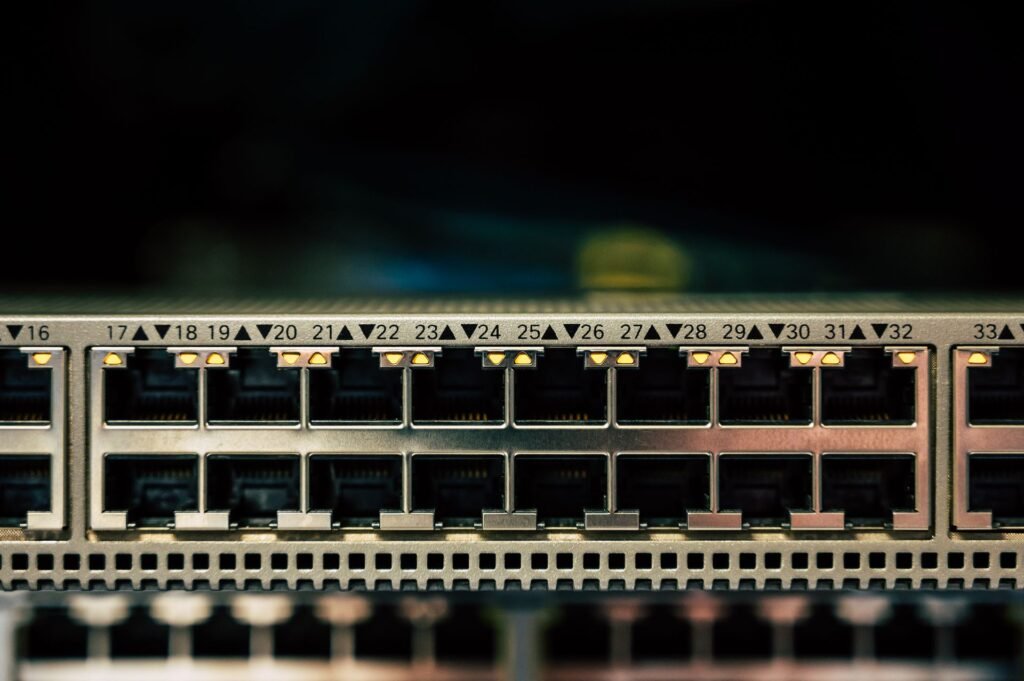
The dividing line is the OSI layer. A layer 7 load balancer, such as NGINX, HAProxy in HTTP mode or an AWS Application Load Balancer, ends the client connection, reads the request and picks a backend, which is exactly what a reverse proxy does. A layer 4 load balancer, such as an AWS Network Load Balancer, picks a backend from connection data without ending the connection or reading HTTP, so it is not acting as a reverse proxy.
AWS shows the split: an Application Load Balancer routes at layer 7, a Network Load Balancer at layer 4, and a Gateway Load Balancer distributes traffic to virtual appliances such as firewalls. Load balancer vs reverse proxy, written the other way round, asks the same question.
| Reverse proxy | Load balancer | |
|---|---|---|
| Primary purpose | Receive and forward client requests | Distribute traffic across backends |
| OSI layer | Layer 7 | Layer 4, layer 7, or both |
| Routing | By hostname, path or rules | By distribution algorithm |
One NGINX server in front of one application, ending TLS and caching responses, is a reverse proxy with nothing to distribute. In practice, one product often does both:
upstream app_backend {
    server 10.0.0.11:8080;
    server 10.0.0.12:8080;
}

server {
    listen 80;
    server_name example.com;

    location / {
        proxy_pass http://app_backend;
    }
}
NGINX uses round robin for the group unless another method is set.
Reverse Proxy vs API Gateway
An API gateway is a reverse proxy with API governance added. It still accepts requests, picks an upstream and returns the response, but it also manages the APIs and their consumers: authentication, API keys, quotas, rate limits, transformation, versioning and analytics. Amazon API Gateway describes its job as accepting and processing up to hundreds of thousands of concurrent API calls, covering traffic management, authorization and version management.
A plain reverse proxy fits general web traffic with simple routing rules. An API gateway earns its place when many APIs share one front door and need the same policies applied consistently: who may call which API, how many calls each consumer gets, and what gets logged.
| Reverse proxy | API gateway | |
|---|---|---|
| Primary purpose | Front and distribute traffic to servers | Govern API traffic and consumers |
| Common traffic | Web apps, static assets, TCP and HTTP | REST, gRPC, GraphQL and WebSocket APIs |
| Authentication | Possible, where configured | Built in, per consumer and per route |
Secure Web Gateway vs Proxy
A secure web gateway, or SWG, is a security control point for web traffic. It sits between users and the internet, inspects requests, enforces policy and blocks threats such as malware, phishing pages and risky downloads. Palo Alto Networks draws the line plainly: an SWG is a complete web traffic security solution, while a proxy server is an intermediary for web requests.
A proxy can filter by URL and hide addresses, but that is not the same as an SWG. An SWG adds malware scanning, URL filtering by category, content inspection, data loss prevention and granular policy by user, device and location. It is usually cloud-delivered, so it covers office and remote workers alike.
| Proxy | Secure web gateway | |
|---|---|---|
| Primary purpose | Route, forward, mask or cache web traffic | Inspect, filter and secure web access |
| Threat protection | Limited, unless paired with security tools | Built in: malware, phishing, risky sites |
| Best fit | Privacy, routing and access control | Organisations securing web use for many users |
An SWG can replace a traditional forward proxy for outbound web security.
MCP Proxy Server vs MCP Gateway
MCP, the Model Context Protocol, is the open protocol AI applications use to reach external tools and data. The specification, revision 2026-07-28, defines a client-host-server architecture: a host is the AI application, each client inside it talks to exactly one server, and servers expose tools, resources and prompts. Messages are JSON-RPC 2.0, over stdio or Streamable HTTP.
An MCP proxy server vs MCP gateway comparison is about what the middle box owns. An MCP proxy forwards requests between AI clients and MCP servers and handles transport: it bridges a local stdio server to HTTP, routes to the right server and returns the response. An MCP gateway does that forwarding and adds governance: it checks who the caller is, whether each tool call is allowed by policy, and logs the decision. A proxy answers whether the request can reach its destination. A gateway answers whether it should be allowed at all, and keeps a record.
Two cautions. First, the MCP specification defines no gateway or proxy role, so both terms are product patterns, not standardised parts of the protocol. Compare what a product actually enforces, not what it calls itself. Second, a solo developer connecting one client to one or two servers usually only needs a proxy, while a team sharing MCP tools, with audit and access control requirements, is the case for a gateway.
Which One Do You Need?
Pick by the problem. Stop unwanted traffic: firewall. Hide your address: forward proxy. Share one public IP: NAT, usually already in your router. Serve a website from one server: reverse proxy. Spread traffic across copies of an app: load balancer. Manage many APIs: API gateway. Secure web use for a team: secure web gateway. Connect an AI client to one or two MCP servers: MCP proxy. Govern shared MCP use: MCP gateway.
Frequently Asked Questions
Is a proxy a firewall?
No. A firewall controls what traffic is permitted between networks with different levels of trust. A proxy makes requests on someone else’s behalf. Some firewalls include proxy functions, but the functions are distinct.
Can a proxy replace a firewall?
No. A forward proxy handles outbound requests and offers no protection against inbound traffic, while a firewall governs the boundary itself. Most networks run both.
Does NAT protect my network like a firewall?
No. NAT hides private addresses by rewriting them, a side effect of sharing one public address, not a security control. NIST treats NAT as a form of routing, not a type of firewall.
Is a load balancer a reverse proxy?
A layer 7 load balancer is, because it ends the client connection, reads the request and forwards it to a backend. A layer 4 load balancer is not: it distributes packets without reading the request. Ask which layer the balancer works at, not what the product is called.
Do I need a reverse proxy if I have only one server?
Often yes. A reverse proxy in front of a single server still ends TLS, caches responses and hides the backend address. You only need load balancing once you have several copies of the same application.
What is the difference between an MCP proxy server and an MCP gateway?
An MCP proxy forwards traffic between AI clients and MCP servers. An MCP gateway also enforces identity, per-tool authorisation and audit logging. Use a proxy for simple connectivity and a gateway when shared MCP use needs governance.
Watch: Proxy, Reverse Proxy and Load Balancer Explained
Proxy vs reverse proxy vs load balancer (2020) | Explained with real life examples – ITkFunde
A plain-English walkthrough of proxy, reverse proxy and load balancer. No affiliate links. Checked live 23 Nov 2026.
The Bottom Line
A firewall decides, a proxy acts on your behalf, NAT rewrites addresses, and a load balancer spreads the work. One product often does several of these jobs, but the jobs themselves stay distinct. Pick by the problem in front of you, not by the label on the box. If you are still fuzzy on the proxy itself, start with what a proxy is.
Sources
13
- NIST, “Guidelines on Firewalls and Firewall Policy”, SP 800-41 Rev. 1 (Sep 2009) – https://www.nist.gov/publications/guidelines-firewalls-and-firewall-policy
- Cloudflare Learning, “What is a reverse proxy?” – https://www.cloudflare.com/en-gb/learning/cdn/glossary/reverse-proxy/
- Cloudflare Learning, “What is a Firewall?” – https://www.cloudflare.com/learning/security/what-is-a-firewall/
- NGINX Documentation, “NGINX Reverse Proxy” – https://docs.nginx.com/nginx/admin-guide/web-server/reverse-proxy/
- Amazon Web Services, “What is Amazon API Gateway?” – https://docs.aws.amazon.com/apigateway/latest/developerguide/welcome.html
- Amazon Web Services, “Elastic Load Balancing types” – https://docs.aws.amazon.com/autoscaling/ec2/userguide/autoscaling-load-balancer.html
- Model Context Protocol, “Architecture”, Spec. 2026-07-28 – https://modelcontextprotocol.io/specification/2026-07-28/architecture/index
- Wikipedia, “Network address translation” – https://en.wikipedia.org/wiki/Network_address_translator
- Red Hat Documentation, “HAProxy Configuration” – https://docs.redhat.com/en/documentation/Red_Hat_Enterprise_Linux/7/html/Load_Balancer_Administration/ch-haproxy-setup-VSA.html
- Check Point, “Firewall vs. Proxy” – https://www.checkpoint.com/cyber-hub/network-security/what-is-firewall/firewall-vs-proxy/
- Palo Alto Networks, “Secure Web Gateway vs. Proxy Server: What Is the Difference?” – https://origin-www.paloaltonetworks.com/cyberpedia/swg-vs-proxy
- Permit.io, “MCP Proxy vs MCP Gateway: Routing vs Governance” – https://www.permit.io/blog/mcp-gateway-vs-mcp-proxy
- API7.ai, “API Gateway vs Reverse Proxy: Differences and Use Cases” – https://api7.ai/blog/api-gateway-vs-reverse-proxy
Every factual claim on this page was verified against a named source above.