
Zero trust cybersecurity is a security model that grants no trust by default and verifies every access request, no matter where it comes from. It replaces the idea that anything inside a company network is safe, putting identity, device health and continuous checks at the centre of defence. This guide explains zero trust, multi-factor authentication (MFA), encryption and the other concepts behind a modern security programme, including how cybersecurity and cloud computing fit together.
The shift matters because the most damaging attacks now start with a stolen login, not a broken firewall. Phishing was the most common initial attack vector in IBM’s Cost of a Data Breach Report 2025, at 16% of breaches, and the average breach cost $4.44 million. Our guide to common cybersecurity threats covers the attacks; this page covers the defences.
What Is Zero Trust in Cybersecurity?
Zero trust is the term for a set of cybersecurity ideas that move defence away from fixed network perimeters and towards users, assets and resources. That is the definition in NIST Special Publication 800-207, Zero Trust Architecture (August 2020). A zero trust architecture (ZTA) uses those ideas to plan enterprise infrastructure. The core rule: no implicit trust is granted based only on physical or network location, or on who owns the asset.
The phrase “never trust, always verify” sums it up: a login from the office gets the same scrutiny as one from a coffee shop. Every request is authenticated, authorised against a policy that considers identity, device state and context, and recorded. The model assumes a breach has happened or will happen, so it limits what one compromised account can reach. Zero trust is not a product. It is an architecture, and no single tool delivers it.
The Seven Tenets of NIST SP 800-207
NIST SP 800-207 sets out seven tenets: all data sources and computing services are resources, so access must be requested for every server, database and application; all communication is secured regardless of network location; access to individual resources is granted on a per-session basis; access is determined by dynamic policy, using identity, device health and behaviour; the enterprise monitors the integrity of its assets continuously; all authentication and authorisation are dynamic and enforced before access; and the enterprise collects as much information as possible about the state of its assets and networks. Together, the tenets move trust off the network and onto continuously verified identity, device state and policy.
Why the Old Perimeter Model Stopped Working
The traditional model drew a fence around the company network, with firewalls controlling traffic in and out and everything inside treated as trusted. That worked when applications and data lived in one building. It stopped working when cloud computing, remote work and personal devices spread resources across many locations.
The Office of Personnel Management breach of 2015 showed the weakness: attackers entered with stolen credentials, then moved sideways inside the perimeter, because inside was treated as safe. An estimated 22.1 million records were exposed. Zero trust answers that failure directly: if every request is verified, a stolen password alone does not open the whole network. Firewalls still have a job, but the perimeter no longer decides trust.
How a Zero Trust Architecture Decides Access
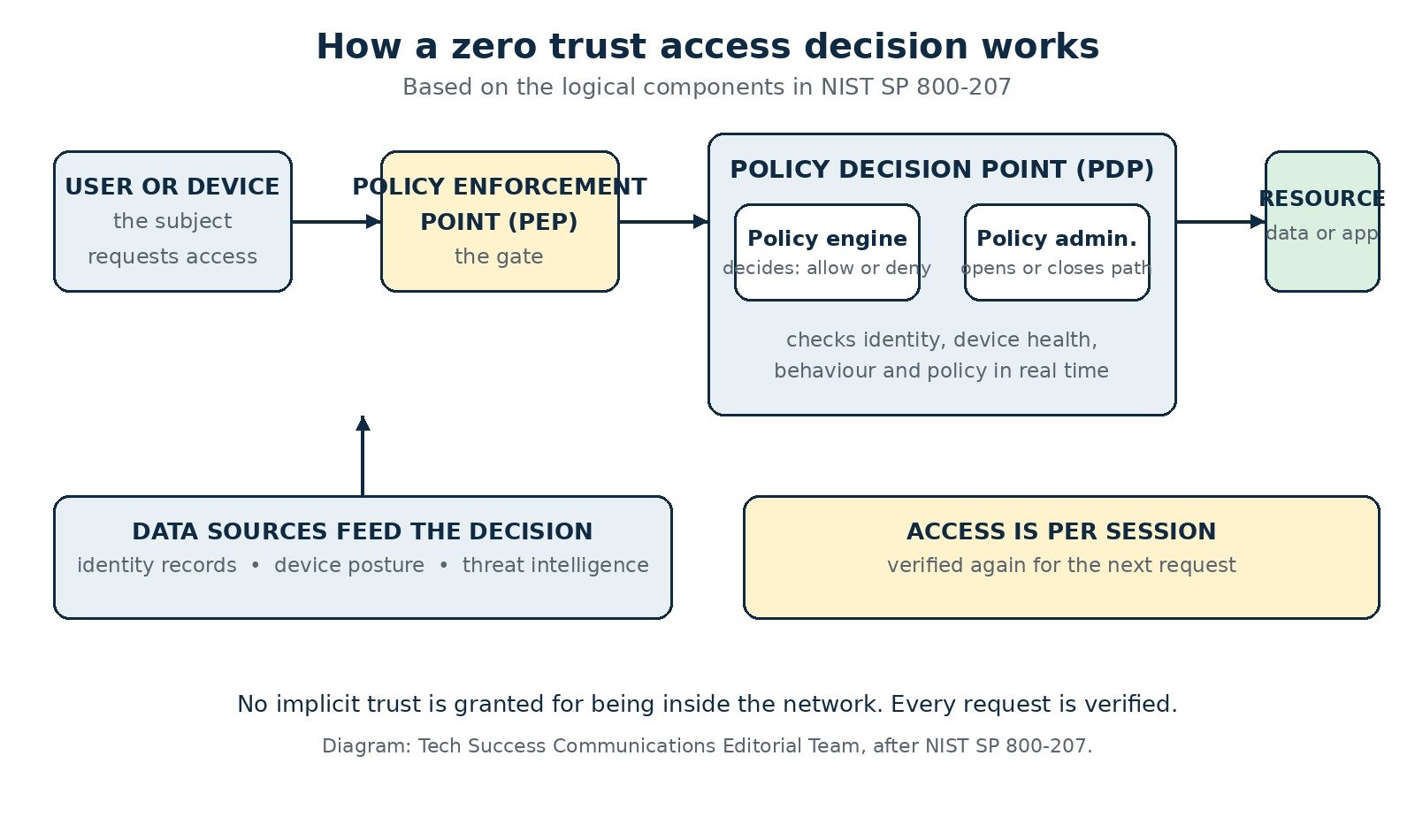
NIST SP 800-207 describes three logical components. The policy engine makes the allow-or-deny decision, weighing policy against identity, device health, behaviour and other signals, and logging it. The policy administrator carries out the decision by opening or closing the connection. Together they form the policy decision point. The policy enforcement point is the gate: it enables, monitors and ends the connection.
The separation matters: the component that decides is not the one that opens the connection, so every decision leaves an audit trail. Access is also granted per session. Logging in once does not open everything; each resource needs its own verified request, and a change in risk can trigger re-verification or cut access mid-session. Trust is checked again and again, not once at the door.
The Five Pillars of the CISA Zero Trust Maturity Model
NIST defines the architecture. CISA’s Zero Trust Maturity Model, version 2.0, published in April 2023, turns it into a plan. It organises zero trust into five pillars, with three capabilities that cut across all of them: visibility and analytics, automation and orchestration, and governance.
Identity: who is making the request and how strongly it is proven. MFA and phishing-resistant authentication sit here. Devices: what device the request comes from, and whether it is known and healthy. Networks: how traffic is segmented and inspected, replacing trust in location with segmentation and encryption. Applications and workloads: how access to apps and services is authorised and monitored, on premises and in the cloud. Data: how data is inventoried, classified and protected at rest and in transit.
Each pillar moves through four maturity stages: Traditional, Initial, Advanced and Optimal. Traditional is manual and static; Optimal makes fully automated, dynamic, least-privilege decisions in real time. Organisations rarely move all five pillars at the same speed, and the model expects that.

MFA in Cybersecurity: What It Is and Why Passwords Are Not Enough
MFA, short for multi-factor authentication, means proving identity with two or more different types of evidence. NIST names three factor types: something you know, such as a password; something you have, such as a phone or a security key; and something you are, such as a fingerprint or a face scan. Two passwords are still one factor, because they are the same type of evidence.
The meaning of MFA in cybersecurity is straightforward: a stolen password alone should not be enough to get in. An attacker who phishes a password still needs the second factor. That is why MFA is the most effective control against credential theft, and why it sits at the heart of zero trust.
MFA methods fall into three groups: authenticator apps that generate a one-time code, push notifications that ask the user to approve a login, and hardware security keys and passkeys that use cryptography tied to the device. They are not equal: a typed code can be relayed by a fake login page in real time, while a key bound to the real site cannot.

Phishing-Resistant MFA and Passkeys
Not all MFA survives phishing. CISA ranks FIDO/WebAuthn authentication and PKI-based MFA at the top of its phishing-resistant MFA guidance. NIST SP 800-63B-4, Digital Identity Guidelines: Authentication and Authenticator Management, finalised in July 2025, gives the formal definition: phishing resistance is the ability of the authentication protocol to prevent secrets and valid authenticator outputs from being disclosed to an impostor verifier, without relying on the vigilance of the person signing in.
The same document is blunt about what does not qualify. Authenticators that involve manual entry of an output, such as one-time passcodes, are not phishing-resistant, because manual entry does not bind the output to the session being authenticated. SMS codes are in the same position, and they carry the extra risk of SIM swapping. At the highest assurance level NIST defines, AAL3, phishing-resistant authentication is required.
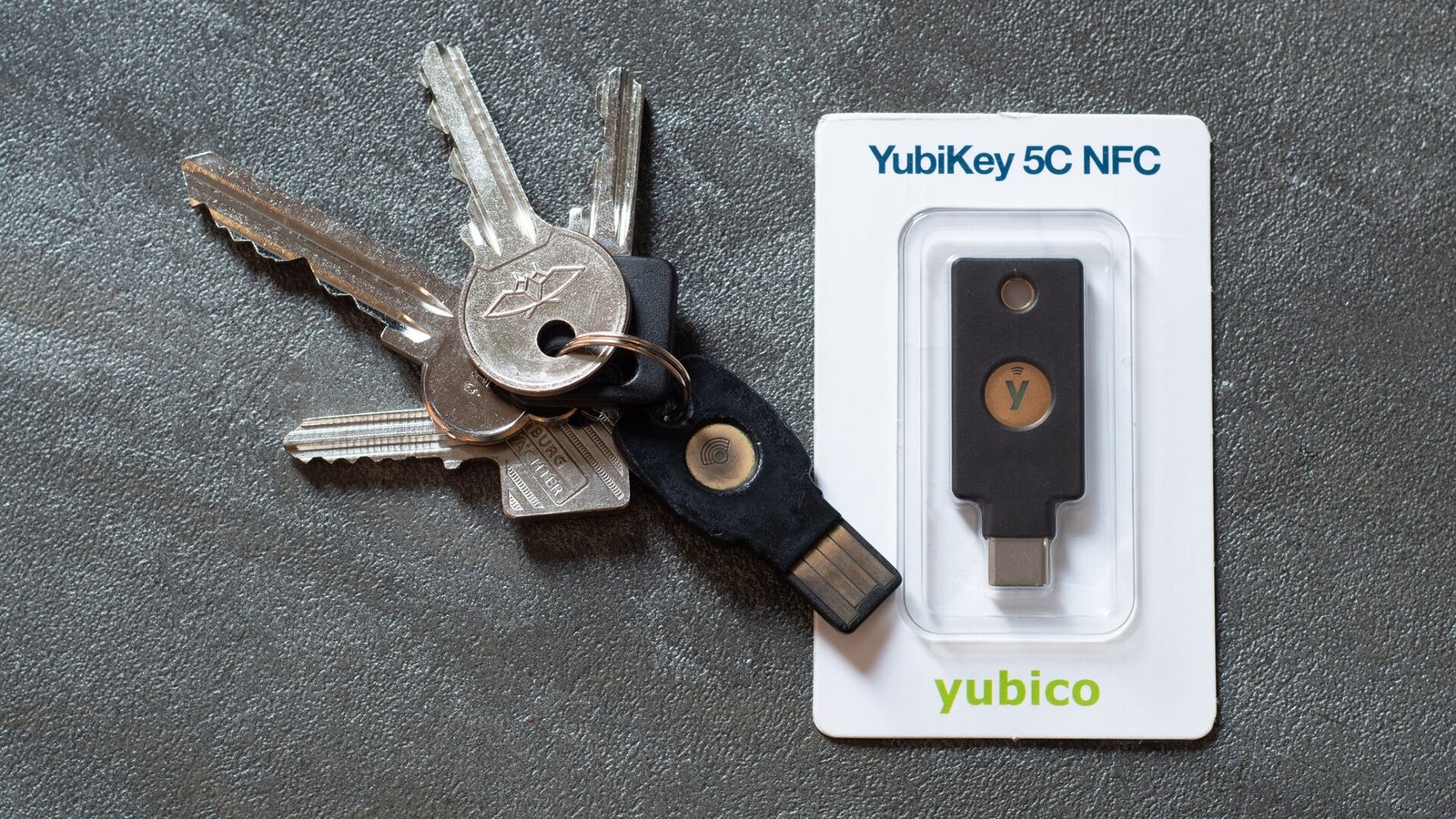
A passkey is a FIDO credential that replaces the password with a pair of cryptographic keys. The private key stays on the user’s device; the public key is stored by the service and can only verify signatures, not create them. The user approves a sign-in as they unlock the device, with a fingerprint, face scan or PIN. Because the credential is bound to the real site’s domain, it does not work on a lookalike site. The FIDO Alliance notes that passwords are responsible for 80% of breaches. The practical order is to turn on MFA everywhere first, then move privileged accounts to phishing-resistant methods.
Encryption in Cybersecurity
Encryption in cybersecurity means scrambling data so that only someone with the right key can read it. It protects data in two states: in transit, while it moves across a network, and at rest, while it sits on a disk or in a database. Without it, anyone who intercepts traffic or gains access to storage can read the contents directly.
The standard behind most modern encryption is AES, the Advanced Encryption Standard, published by NIST as FIPS 197: the algorithm behind the browser padlock, encrypted messaging and encrypted storage. Key management matters as much as the algorithm, because a leaked key undoes the protection entirely.
Encryption also shapes the data life cycle in cybersecurity: data is created, stored, used, shared, archived and deleted, and each stage needs fitting protection. Data that is no longer needed should be deleted securely, because stored data is data that can be stolen. Classifying data first is part of the Data pillar of the CISA model.
Post-Quantum Cryptography
The public-key cryptography used today for key exchange and digital signatures would be broken by a large quantum computer. NIST answered with three post-quantum cryptography standards, finalised in August 2024: FIPS 203 (ML-KEM key encapsulation), FIPS 204 (ML-DSA signatures) and FIPS 205 (SLH-DSA signatures). For most small organisations, the step is to ask vendors about their post-quantum roadmaps and keep cryptographic inventories up to date, which is the core of PQC cybersecurity planning.

Defense in Depth: Layered Security
Defense in depth is a strategy that layers multiple independent security controls across an environment, so that the failure of any one control does not lead to a breach. The idea was developed by the US National Security Agency as a comprehensive approach to information assurance, and it remains a core principle of network security.
Cybersecurity defense in depth organises its layers into three categories: physical controls such as locked server rooms and badge readers; technical controls such as firewalls, encryption, intrusion detection and MFA; and administrative controls such as training, access reviews and incident response plans. A programme strong on technical controls but missing training fails the moment a user is phished. Zero trust and defense in depth work together: zero trust supplies the verification logic, and defense in depth supplies the layers that catch what verification misses.
What Is a Sandbox in Cybersecurity?
A sandbox in cybersecurity is a restricted, controlled execution environment where untrusted software can run without reaching the rest of a system. NIST defines it as an environment that prevents potentially malicious software from accessing any system resources except those for which the software is authorised.
Security teams use a cybersecurity sandbox in two ways: containment, where a suspicious file runs inside so any damage stays inside; and analysis, where analysts watch what the sample does and use that behaviour to write detection rules. That is why sandboxes are a standard part of malware analysis and email security.
Sandbox cybersecurity tools have limits. Some malware checks whether it is running in a virtual machine or a sandbox and stays quiet if it detects one. MITRE ATT&CK lists this as Virtualization/Sandbox Evasion (T1497). A sandbox is one layer in a defense in depth design, not a guarantee.
Cloud Cybersecurity and the Shared Responsibility Model
Cloud cybersecurity covers the protection of data, applications and infrastructure in cloud environments. The shared responsibility model describes the split: the provider secures the infrastructure, while the customer secures what they put on it, including data, identities and access settings.
That split is why cloud computing and cybersecurity meet at identity and configuration: misconfigured storage and over-permissioned accounts cause more cloud breaches than attacks on the provider’s infrastructure. The same zero trust ideas apply: verify every access, grant least privilege, encrypt data, and monitor continuously.
Cybersecurity with cloud computing also raises how cloud security differs from cybersecurity as a whole. Cybersecurity is the wider field; cloud security is the part that deals with cloud environments. Comparing cybersecurity vs cloud security is a matter of scope, not a choice between alternatives. The cybersecurity implications of cloud computing are mostly about this split: who secures what, and what happens when the line is misunderstood. Cybersecurity and the cloud are now inseparable for most organisations.
SASE and Cloud-Native Security
SASE, short for secure access service edge, is a cloud-delivered model that converges networking and security into a single service; Gartner coined the term in 2019. A SASE cybersecurity platform typically combines SD-WAN with a secure web gateway, a cloud access security broker, firewall as a service and zero trust network access (ZTNA). Protection follows the user, wherever they are. That is the meaning of SASE in cybersecurity: security delivered as a cloud service, not as boxes in a data centre.
Cloud native cybersecurity means security built for applications that run as containers and microservices in the cloud, rather than added on afterwards: workload identity, container scanning and runtime protection. Cloud based cybersecurity services deliver these controls as a service, which suits small teams. The comparison many organisations make is cybersecurity vs cloud computing: whether to keep systems on premises or move them to the cloud. A well-run cloud environment with MFA, encryption and monitoring is safer than a neglected server room, and the reverse is also true.
Zero Trust vs VPN: What Changes for Remote Access
A traditional VPN gives a remote worker a tunnel into the company network, and once inside, the worker often has broad access: the perimeter model extended to remote staff, with the same weakness. One stolen VPN credential can open a wide area. Our guide to VPN vs ZTNA and SASE compares the two approaches in detail.
ZTNA, zero trust network access, replaces the broad tunnel with per-application access: the user is connected only to the specific application they are allowed to use. Firewall cybersecurity controls still matter in both designs; our guide to VPN vs firewall explains where each fits. Our guide to proxy vs firewall, NAT and load balancer covers how proxies differ at the network edge.

How to Start With Zero Trust
Zero trust is a multi-year programme, not a weekend project. Following the CISA maturity model: inventory identities, devices and data first; turn on MFA everywhere, starting with privileged accounts, then move to phishing-resistant methods; segment the network; encrypt and classify data; centralise logging and monitoring; and review access regularly. Small organisations can start with the first two steps and already be far ahead of a password-only setup.
Penetration Testing and Red Teaming
Defences need checking by someone trying to break them. Our guide to cybersecurity penetration testing explains how authorised testers probe for weaknesses and how red teams simulate real attackers to test detection and response.
Related reading: VPN vs ZTNA / SASE compares zero trust network access with a traditional VPN. VPN vs Firewall explains where each control fits. Proxy vs Firewall, NAT & Load Balancer covers how proxies differ from firewalls at the network edge.
Frequently Asked Questions
What is zero trust in cybersecurity?
Zero trust grants no trust by default and verifies every access request. NIST SP 800-207 defines it as an approach that moves defence from network perimeters to users, assets and resources, with authentication and authorisation before each session.
What is the zero trust cybersecurity model?
The zero trust cybersecurity model is the set of principles behind zero trust architecture: never trust, always verify; least-privilege access; and assume breach. NIST SP 800-207 sets out seven tenets, and CISA’s Zero Trust Maturity Model v2.0 organises the work into five pillars and four maturity stages.
What is MFA in cybersecurity?
MFA, multi-factor authentication, means proving identity with two or more types of evidence: something you know, something you have, and something you are. It stops a stolen password from being enough to get in.
What does MFA mean in cybersecurity for a small business?
MFA meaning in cybersecurity is the same at any size: a second check beyond the password. For a small business, the practical step is to turn on MFA for email, cloud accounts and remote access first, then move privileged accounts to phishing-resistant methods such as passkeys or hardware keys.
What is encryption in cybersecurity?
Encryption in cybersecurity, also called cybersecurity encryption, scrambles data so only someone with the right key can read it. It protects data in transit and at rest, and the standard behind most modern encryption is AES, published by NIST as FIPS 197. Encryption for cybersecurity is therefore a baseline control, not an optional extra.
What is a sandbox in cybersecurity?
A sandbox is a restricted, controlled environment where untrusted software runs without reaching the rest of a system. Security teams use it to detonate suspicious files safely and observe what malware does.
What is SASE in cybersecurity?
SASE, secure access service edge, is a cloud-delivered model that converges networking and security into a single service. Gartner coined the term in 2019. Cybersecurity SASE platforms typically combine SD-WAN with a secure web gateway, a cloud access security broker, firewall as a service and zero trust network access.
What is a zero trust architecture?
A cybersecurity zero trust architecture puts zero trust principles into practice: policy engines decide access, policy administrators enforce it, and policy enforcement points gate each connection. NIST SP 800-207 is the reference document.
How is cloud cybersecurity different from traditional cybersecurity?
Cloud cybersecurity deals with data, applications and infrastructure in cloud environments, under a shared responsibility model where the provider secures the infrastructure and the customer secures their data, identities and settings. Traditional cybersecurity covers all systems; cybersecurity cloud security is the part that deals with the cloud.
Watch: Zero Trust and MFA Explained
Zero Trust Architecture Explained: NIST SP 800-207 Deconstructed, Learn AI with G
A 96-second walkthrough of NIST SP 800-207, covering the policy enforcement point, the policy decision point and why the perimeter model failed. Checked live on 23 Nov 2026.
Multi-Factor Authentication (MFA) Explained, HMOK
A 4-minute explainer on the three authentication factors and why passwords alone are not enough. Checked live on 23 Nov 2026.
Sources
13
- NIST, SP 800-207, “Zero Trust Architecture” (Aug 2020): https://www.nist.gov/publications/zero-trust-architecture
- NIST, “Zero Trust Cybersecurity: ‘Never Trust, Always Verify'”: https://www.nist.gov/blogs/taking-measure/zero-trust-cybersecurity-never-trust-always-verify
- CISA, “Zero Trust Maturity Model, Version 2.0” (Apr 2023): https://www.cisa.gov/zero-trust-maturity-model
- NIST, SP 800-63B-4, “Digital Identity Guidelines: Authentication and Authenticator Management” (Jul 2025): https://csrc.nist.gov/pubs/sp/800/63/b/4/final
- CISA, “Phishing-Resistant MFA” fact sheet (Oct 2022): https://www.cisa.gov/sites/default/files/publications/fact-sheet-implementing-phishing-resistant-mfa-508c.pdf
- FIDO Alliance, “FIDO Passkeys: Passwordless Authentication”: https://fidoalliance.org/passkeys/
- NIST, FIPS 197, “Advanced Encryption Standard (AES)”: https://www.nist.gov/publications/advanced-encryption-standard-aes
- NIST, “Post-Quantum Cryptography FIPS Approved” (Aug 2024): https://csrc.nist.gov/news/2024/postquantum-cryptography-fips-approved
- IBM, “Cost of a Data Breach Report 2025”: https://www.ibm.com/reports/data-breach
- NIST CSRC Glossary, “Sandbox”: https://csrc.nist.gov/glossary/term/sandbox
- MITRE ATT&CK, “Virtualization/Sandbox Evasion (T1497)”: https://attack.mitre.org/techniques/T1497/
- Wikipedia, “Secure access service edge”: https://en.wikipedia.org/wiki/Secure_access_service_edge
- Huntress, “What Does Zero Trust Architecture Do?”: https://www.huntress.com/cybersecurity-101/topic/what-does-zero-trust-architecture-do
Every factual claim on this page was verified against a named source above.