
By Tech Success Communications Editorial Team | Checked 23 Nov 2026

A cybersecurity strategy is a written plan that connects business goals to the security work that protects them. It names what matters most, who owns each risk, and how progress will be measured. This guide builds that plan step by step, using the NIST Cybersecurity Framework 2.0 and guidance from CISA. For supporting habits, see our cybersecurity tips and best practices.
What Is Cybersecurity Management?
Cybersecurity management is the ongoing work of planning, coordinating, monitoring, and improving how an organization handles cyber risk. It covers governance, risk assessment, asset and identity management, vulnerability handling, detection, incident response, and recovery. The point is coordination: tools alone do not make a program, and a program is what turns individual controls into reliable protection.
A strategy sits above the day-to-day work. It explains which outcomes the business needs, why they matter, and what will be funded first. A roadmap then sequences the work, policies set the rules, and procedures explain how people carry them out.
Why a Strategy Comes Before Tools
Buying security tools before writing a strategy usually ends with tools nobody configures, monitors, or maintains. A product only reduces a defined risk when someone can set it up, watch its alerts, patch it, and respond when it fires.
The business case is straightforward. IBM’s Cost of a Data Breach Report 2025 put the global average cost of a data breach at USD 4.44 million, down from USD 4.88 million in 2024, while the average cost in the United States reached USD 10.22 million. Those figures describe averages across 600 organizations studied between March 2024 and February 2025. They do not predict what any single organization will pay, but they show why leadership should treat cyber risk as a business risk, not an IT expense.
The Framework: NIST CSF 2.0
The NIST Cybersecurity Framework (CSF) 2.0, published in February 2024, organizes cybersecurity risk management around six functions: Govern, Identify, Protect, Detect, Respond, and Recover. NIST describes it as voluntary guidance for organizations of any size and sector, built around outcomes
rather than a fixed list of products. Govern is new in CSF 2.0, and NIST places it at the center because it shapes the other five.
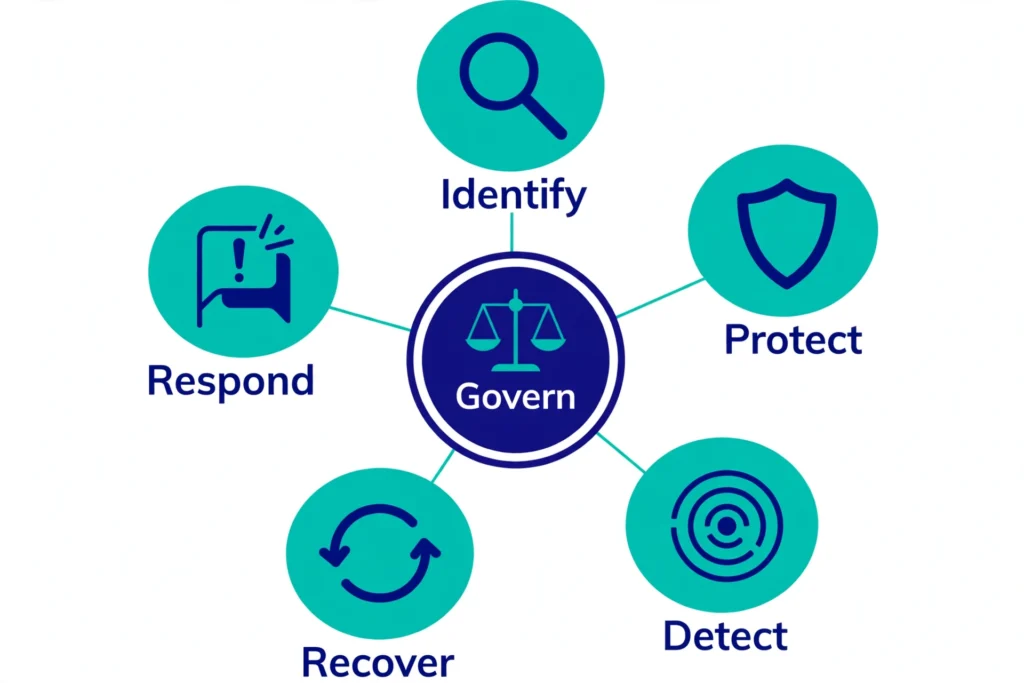
The framework also uses Profiles to record the current state and the target state. The steps below follow the six functions in order, even though the work itself runs continuously.
Step 1: Govern the Program
Govern covers strategy, roles, accountability, risk tolerance, policy, and oversight. It also covers supply chain risk, which means the security of suppliers and the technology an organization buys. Start here, because every later step needs a decision-maker.
Name one accountable leader for cybersecurity, even in a small organization. If there is no chief information security officer, assign the role to a named executive, IT leader, or external adviser. Record who approves risk acceptance, who owns the budget, and who reports to the board or the owner. A risk accepted by nobody is a risk nobody manages.
Write a short risk appetite statement: which risks the organization will not accept, which it will tolerate, and what evidence leadership needs before it signs off. Add a policy approval calendar and an exception process with expiry dates.
Step 2: Identify What Matters and What Threatens It
Identify means understanding the organization’s assets, data, systems, and the risks to them. An organization cannot protect assets it does not know it has, so the inventory comes first. Exposure management in cybersecurity is the continuous side of this work: finding and reducing the ways attackers can reach the organization, such as unknown assets, unpatched internet-facing systems, excessive privileges, and forgotten accounts.
List hardware, software, cloud services, SaaS applications, data stores, accounts, and internet-facing services. Include assets the organization does not own but depends on, such as a payroll provider or a payment processor. For each critical asset, record its owner, the business process it supports, and the data it handles.
Then assess risk. A risk assessment weighs threats, vulnerabilities, existing controls, likelihood, and business impact. Common threat categories include credential theft and phishing, ransomware, business email compromise, internet-facing vulnerabilities, cloud misconfiguration, insider misuse, and third-party compromise. Score risks on a consistent scale, and record the assumptions behind each rating. A score is a decision aid, not a measurement of reality.
Step 3: Protect What You Have
Protect covers the safeguards that reduce the likelihood or impact of an incident. The highest-value safeguards are usually the least glamorous ones.
Start with identity. Require multi-factor authentication, prioritizing phishing-resistant methods for privileged accounts, and separate everyday accounts from administrator accounts. Remove dormant accounts and apply least privilege, so each account holds only the access its work needs. Our guide to zero trust, MFA, and key security concepts explains these controls in more detail.
Next, cover the basics that attackers exploit most often: patch known vulnerabilities in internet-facing systems promptly, keep endpoints centrally managed, use secure configurations, encrypt sensitive data, and protect email with sender authentication. Train staff to recognize phishing and to report suspicious messages quickly. See our guide to cybersecurity awareness training for employees.
Small organizations should not copy an enterprise security department. CISA’s Cross-Sector Cybersecurity Performance Goals (CPGs) offer a voluntary, prioritized baseline of high-impact practices, including asset inventory, changed default passwords, multi-factor authentication, and incident response plans.
Step 4: Detect Problems Early
Detect means finding possible attacks and compromises in time to act. Prevention fails sometimes, and detection decides how much damage follows.
Decide which log sources matter, collect them in one place, and make sure someone reviews the alerts. Cover identity, endpoints, cloud services, email, and network signals. An alert nobody reads is the same as no alert at all.
Step 5: Respond When an Incident Happens
Respond covers the actions taken once an incident is detected: triage, containment, investigation, eradication, and communication. Write the incident response plan before it is needed, and name the people who decide each step.
The plan should list incident contacts, legal and insurance contacts, escalation paths, containment options, evidence preservation, and who speaks to staff, customers, and regulators. CISA’s performance goals call for response plans that are created, maintained, and exercised, not just filed away. Run a tabletop exercise at least once a year, and again after a major change.

Step 6: Recover and Improve
Recover means restoring the assets and operations affected by an incident, and learning from it. Backups are the core of recovery, but only backups that have been restored in practice count.
Keep backups protected from ordinary administrative compromise, store a copy offsite or offline, and restore them regularly to prove they work. Record recovery priorities in advance: which systems come back first and what manual workarounds keep the business running meanwhile.
Build a Current Profile and a Target Profile
A Current Profile records what the organization actually does today, with evidence. Assess both whether a control exists and whether it works: a backup job can run every night and still fail to restore.
A Target Profile describes the security outcomes the organization needs, based on business risk and risk appetite. Make each target specific enough to verify, with coverage, an owner, evidence, and a deadline. “Improve endpoint security” is too vague. “By the end of next quarter, all company-managed endpoints will be centrally managed, protected by monitored endpoint security, and reporting patch and encryption status” can be checked.
Compare the two profiles, and the gaps become the work list. Rank each gap by risk reduction, business criticality, coverage, cost, effort, dependencies, and time to benefit.
A Cybersecurity Implementation Plan
A cybersecurity implementation plan turns the gaps into a sequenced roadmap. Sequence matters, because some work depends on earlier work: useful detection depends on logging, and recovery testing depends on restoration priorities.
Phase 0: immediate risk reduction. Enforce multi-factor authentication on administrative accounts, remove dormant accounts, confirm backups exist, patch critical internet-facing vulnerabilities, and establish incident contacts.
Phase 1: visibility and governance. Approve the charter, complete asset and supplier inventories, set up the risk register and exception process, and set baseline metrics.
Phase 2: foundational protection. Centralize endpoint management, improve least privilege, standardize secure configurations, improve patching, classify sensitive data, and strengthen backups.
Phase 3: detection and response. Define log sources, assign alert triage, write playbooks for ransomware, account takeover, and data loss, and run tabletop exercises.
Phase 4: resilience and optimization. Restore systems under realistic conditions, measure control effectiveness, retire duplicative tools, and reassess risk appetite.
For each initiative, record the risk, the owner, the cost, the timeline, and the measure that will show whether it worked.

Cybersecurity Metrics for the Board
Cybersecurity metrics for the board should help leadership decide whether to fund, accelerate, change, or accept a risk. Each metric needs a trend, an owner, a target, and a note on data confidence.
A useful board dashboard covers coverage, speed, and governance: critical assets inventoried, accounts using multi-factor authentication, endpoints under central management, critical suppliers assessed, time to patch critical vulnerabilities, time to detect and recover, overdue exceptions, and accepted risks past review.
Cybersecurity metrics and measures should be chosen with care. Training completion, tool counts, and blocked-attack totals describe activity, not risk reduction. A cybersecurity metrics dashboard earns its place when every figure on it connects to a decision the board can actually make. Report the same metrics each quarter so trends are visible.
Cybersecurity performance management is the discipline behind that dashboard: setting targets, reviewing them on a schedule, and acting when a metric misses.
What Small Organizations Should Do First
A small organization does not need an enterprise program. It needs a proportionate one that someone monitors and maintains. NIST publishes a small-business quick-start guide for CSF 2.0, and CISA’s performance goals point the same way: start with identity and multi-factor authentication, secure email, endpoint management, patching, protected backups, restoration testing, basic logging, incident contacts, supplier oversight, and practical security awareness.
Common Mistakes in Cybersecurity Strategies
Treating compliance as security. Passing an audit shows that controls were documented at a point in time. It does not prove the organization can detect or recover from an attack. Map requirements separately, and do not let a certificate replace a risk assessment. A strategy without named owners, deadlines, and a review date will be ignored the week after it is approved.
Forgetting suppliers. Vendors, contractors, and cloud providers can introduce risk the organization cannot see directly. Assess critical suppliers before signing, set contractual security requirements, and limit third-party access.
Skipping the recovery exercise. Backups, incident plans, and manual workarounds all look good on paper. Until they are exercised, nobody knows whether they work under pressure.
For background, see our guide to common cybersecurity threats and attacks, the types of cybersecurity, and the cybersecurity glossary. The pillar page what is cybersecurity gives the full overview.

Frequently Asked Questions
What is the difference between a cybersecurity strategy and a cybersecurity plan?
A strategy explains which security outcomes the business needs and why. A plan sequences the work that achieves those outcomes, with owners, costs, and dates. Policies set the rules, and procedures explain how people carry them out.
How often should a cybersecurity strategy be updated?
Review it at least once a year, and again after an incident, a major technology change, an acquisition, or a new regulatory obligation. Update the Current Profile, risk register, and Target Profile together.
What framework should a small business use?
NIST CSF 2.0 works for most organizations because it is voluntary, outcome-based, and scales to any size. CISA’s Cross-Sector Cybersecurity Performance Goals give a shorter, prioritized baseline of high-impact practices to start from. Use CSF 2.0 to organize the program and the CPGs to choose the first actions.
Who should own the cybersecurity strategy?
One named leader should be accountable, usually the chief information security officer where one exists. In a smaller organization, assign the role to a named executive or external adviser. Business owners define what matters and what downtime they can tolerate.
What metrics should the board see?
Asset inventory coverage, multi-factor authentication coverage, critical vulnerability patch time, backup restore success, time to detect and recover, overdue exceptions, and accepted risks past review.

Watch: The NIST Framework, Explained
- “NIST Cybersecurity Framework Explained” — Flat Earth Networking
A plain-English walkthrough of the NIST framework for small business owners, with two worked examples. Chapters run to 37:00. Checked live on 23 Nov 2026.
2. “NIST’s 5 Steps to initiate and/or integrate NIST Cybersecurity Framework 2.0 at your organization” — Certified Information Security
Allen Keele outlines NIST’s five steps for starting CSF 2.0, including roles and a RACI matrix. Chapters run to 9:30. Published 6 Jul 2024. Checked live on 23 Nov 2026.
Sources
8
- US National Institute of Standards and Technology, “The NIST Cybersecurity Framework (CSF) 2.0” — https://www.nist.gov/cyberframework
- US Cybersecurity and Infrastructure Security Agency, “Cross-Sector Cybersecurity Performance Goals (CPGs)” — https://www.cisa.gov/cybersecurity-performance-goals-cpgs-0
- US Cybersecurity and Infrastructure Security Agency, “Take the First Steps Towards Better Cybersecurity With these Four Goals” — https://www.cisa.gov/news-events/news/take-first-steps-towards-better-cybersecurity-these-four-goals
- IBM, “Cost of a Data Breach Report 2025” — https://www.ibm.com/downloads/documents/us-en/137a3e32273ed1f5
- University of Tulsa Online, “Your Guide to Security Management in Cybersecurity” — https://online.utulsa.edu/blog/cybersecurity-management/
- Fortinet, “What Is Cybersecurity Management?” — https://www.fortinet.com/resources/cyberglossary/cybersecurity-management
- SentinelOne, “Cyber Security Management: Frameworks and Best Practices” — https://www.sentinelone.com/cybersecurity-101/cybersecurity/cyber-security-management/
- iTechGuides, “Building a Cybersecurity Strategic Plan: Steps, Frameworks, and Roadmap” — https://www.itechguides.com/building-a-cybersecurity-strategic-plan-a-practical-guide/
Every factual claim on this page was verified against a named source above.