
By Tech Success Communications Editorial Team | Checked 23 Nov 2026

This cybersecurity glossary explains the key cybersecurity terms and definitions you need to know in plain English, from APT and the CIA triad to honeypots and the cyber kill chain. Each definition is short and checked against the glossaries published by NIST, CISA, and the UK National Cyber Security Centre.
The terms appear in alphabetical order, with each acronym spelled out on first use. For practical advice on putting these ideas to work, see our cybersecurity tips.
How to Use This Glossary
Use this page as a reference for cybersecurity definitions, not a course. Look up a term when it appears in a report, a job description, or a vendor pitch, and read the one-line example to see what it means in practice. The cybersecurity acronyms here are the ones that show up most often in beginner guides, security job listings, and audit reports. The page covers 25 terms in total.
Cybersecurity Terms A to C
ABAC (Attribute-Based Access Control)
ABAC is a way of deciding who can access something based on attributes, such as a person’s role, the device they use, their location, and the sensitivity of the data. Instead of a simple yes-or-no list of users, the system checks the attributes against a policy each time access is requested.
APT (Advanced Persistent Threat)
An advanced persistent threat is a skilled attacker, often linked to a nation-state, that runs a sustained campaign against a target. CISA describes it as a threat actor with the resources to conduct a long campaign, spending time learning the target before breaking in and then staying inside the network undetected to steal data or watch activity over months. An APT is defined by patience and persistence, not by a single clever piece of malware.

CIA Triad (Confidentiality, Integrity, Availability)
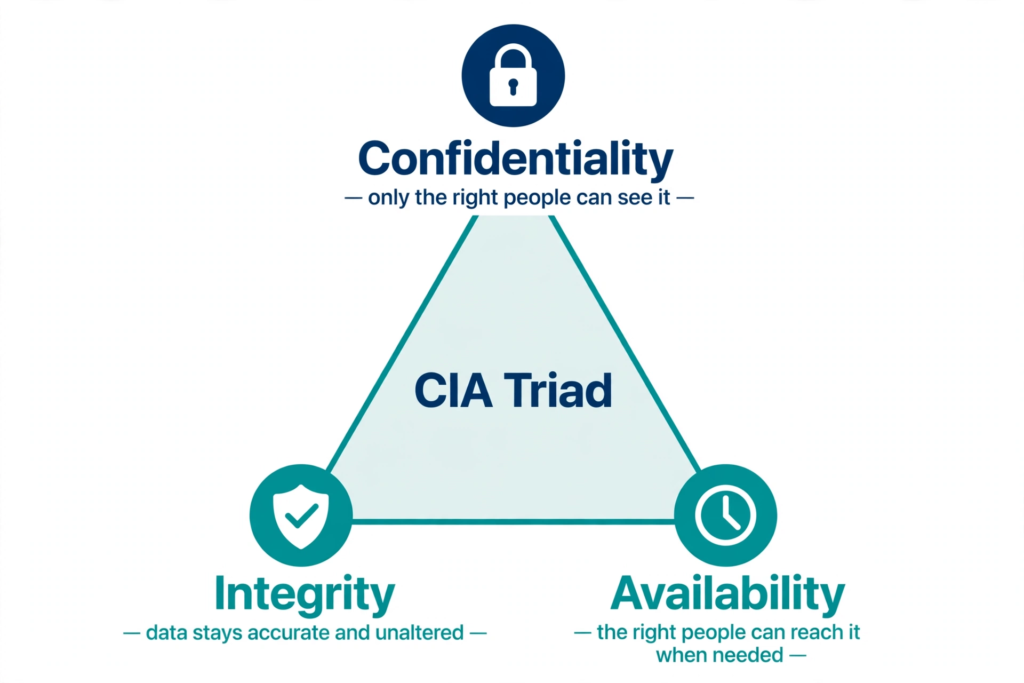
The CIA triad is the model at the centre of information security. It names the three properties every security control exists to protect. The letters stand for confidentiality, integrity, and availability, and they have nothing to do with the intelligence agency of the same initials.
Confidentiality means keeping information from people who should not see it. Encryption and access controls protect it, and a leaked database is a confidentiality failure. Integrity means information stays accurate and unaltered, which hashing and digital signatures help to prove. Availability in cybersecurity means the people who need information can reach it when they need it, so backups and protection against denial-of-service attacks protect it. NIST defines all three in FIPS 199, the standard for categorising federal information systems.
Cybersecurity Terms C to H
CTEM (Continuous Threat Exposure Management)
CTEM is a programme, introduced by Gartner in 2022, for continuously finding, ranking, checking, and fixing the exposures an attacker could use. It runs as a five-stage loop: scoping, discovery, prioritisation, validation, and mobilisation. Unlike a one-off vulnerability scan, CTEM repeats, because the attack surface changes every time a service ships or an employee leaves.
CTI (Cyber Threat Intelligence)
Cyber threat intelligence is information about threats that has been collected, analysed, and put in a form a team can act on. It covers who is attacking, what methods they use, and which indicators, such as malicious domains or file hashes, to watch for.
CVE (Common Vulnerabilities and Exposures)
A CVE is a unique public ID for one specific, publicly known software vulnerability, written as CVE-YYYY-NNNNN, for example CVE-2021-44228 for Log4Shell. The CVE Program, coordinated by MITRE, gives every known flaw one name so vendors, researchers, and scanners all refer to the same issue. A CVE ID names the flaw; it does not say how severe it is. Severity is scored separately, on the CVSS scale from 0 to 10.
DLP (Data Loss Prevention)
Data loss prevention covers the policies and tools that stop sensitive data from leaving an organisation in ways it should not. A DLP tool can block a spreadsheet of customer records being emailed to a personal address, or warn when someone uploads source code to a public file-sharing site. It watches data in use, in transit, and at rest, and it works best when the organisation has first decided which data counts as sensitive.
Honeypot
A honeypot is a decoy system or resource designed to attract intruders. NIST defines it as a system, such as a web server, or a system resource, such as a file on a server, “designed to be attractive to potential crackers and intruders, like honey is attractive to bears”. Because a honeypot has no legitimate business use, any interaction with it is a strong sign of an intruder. A network of honeypots is called a honeynet, and a decoy piece of data, such as a fake credential, is a honeytoken.
HSM (Hardware Security Module)
A hardware security module is a physical device built to generate, store, and use cryptographic keys safely. Keys never leave the device in readable form, which makes stealing them far harder than copying a file from a server. Banks, certificate authorities, and cloud providers use HSMs to protect the keys that sign certificates and encrypt data.
Cybersecurity Terms I to N
IDS (Intrusion Detection System)
An intrusion detection system watches network traffic or system activity and raises an alert when it sees something suspicious, such as a known attack pattern or unusual behaviour. It detects and reports; it does not block the traffic itself. That is the job of its partner, the IPS.
IPS (Intrusion Prevention System)
An intrusion prevention system sits in the path of network traffic, inspects it, and blocks what it judges malicious. It is an IDS with the power to act, dropping a malicious connection or resetting it before the attack reaches its target. The risk is a false positive blocking legitimate traffic, so IPS rules need tuning after deployment.
Kill Chain (Cyber Kill Chain)
The cyber kill chain is a model from Lockheed Martin, published in 2011, that breaks a targeted intrusion into seven sequential stages: reconnaissance, weaponisation, delivery, exploitation, installation, command and control, and actions on objectives. The idea is that an attacker must complete every stage to succeed, while defenders only need to stop one.

Least Privilege
Least privilege is the practice of giving each user, program, or device only the minimum access needed to do its job, and nothing more. CISA states it as assigning users the minimum required permissions to access data and systems for their daily functions. When one account is compromised, least privilege limits what the attacker can reach.
NAC (Network Access Control)
Network access control decides which devices may join a network, based on policy. Before a laptop or phone gets full access, NAC checks things like whether it belongs to the organisation, whether its software is up to date, and whether the user has authenticated. A device that fails the checks may be quarantined to a limited network or blocked outright.
NAT (Network Address Translation)
Network address translation maps private IP addresses inside a network to a public IP address when traffic leaves for the internet, and maps replies back to the right device. It lets many devices share one public address, and it hides internal addresses from the outside. NAT is a networking function, not a security control on its own, although hiding internal addresses does make casual scanning harder.
NDR (Network Detection and Response)
Network detection and response tools monitor network traffic continuously, analyse it for signs of attack, and help teams respond. Where an IDS mainly alerts on known patterns, NDR leans on behavioural analysis to spot unusual traffic, such as a workstation suddenly sending large volumes of data to an unknown server.
Cybersecurity Terms P to S
PKI (Public Key Infrastructure)
Public key infrastructure is the system of certificates, certificate authorities, and key pairs that lets strangers trust each other online. When you visit a website over HTTPS, PKI is what lets your browser check the site’s certificate and set up an encrypted connection. A certificate binds a public key to an identity, such as a domain name, and a certificate authority vouches for that binding. If the chain of trust breaks, the padlock in the browser means nothing.

Pyramid of Pain
The Pyramid of Pain, created by researcher David Bianco in 2013, ranks indicators of compromise by how hard they are for an attacker to change once defenders block them. From easiest to hardest for the attacker, the six levels are hash values, IP addresses, domain names, network and host artifacts, tools, and tactics, techniques, and procedures (TTPs). Blocking a hash costs the attacker almost nothing, since they can recompile the malware. Forcing them to change their TTPs costs far more.
SBOM (Software Bill of Materials)
A software bill of materials is a formal list of every component and dependency inside a piece of software, like an ingredients list. When a new CVE is published, a team with an SBOM can check in minutes whether any of its products contain the affected component. CISA publishes minimum elements for an SBOM, covering supplier, component, version, and dependency relationships. Without one, answering “are we affected?” means searching by hand.
SCAP (Security Content Automation Protocol)
SCAP is a suite of NIST specifications for automating security checks, such as verifying system configurations and listing known vulnerabilities. Tools that speak SCAP can scan a machine, compare its settings against a standard checklist, and report what is out of line, all in a format other tools can read. It is the plumbing that lets vulnerability scanners and compliance tools share results instead of each inventing its own format.
Separation of Duties
Separation of duties means no single person controls every step of a critical process. The person who approves a payment should not be the person who sends it, and the developer who writes code should not be the one who approves it for release. The point is to make fraud or error require collusion rather than one person’s action. It is a control against insider risk as much as against mistakes.
STIG (Security Technical Implementation Guide)
A STIG is a configuration standard published by the US Defense Information Systems Agency (DISA) that sets out how to secure a specific product, such as an operating system, a database, or a web server. Each STIG lists settings to change, services to disable, and checks to run, with a severity rating for each finding.
Cybersecurity Terms T to Y
Tailgating
Tailgating, also called piggybacking, is a physical social engineering technique in which an unauthorised person follows an authorised person through a secured door without presenting credentials. It works on politeness: someone holding a box asks you to hold the door, and you do. NIST lists tailgating as a form of social engineering, and the usual defences are badge readers, mantraps, and a culture of challenging strangers politely.
Whaling
Whaling is phishing aimed at senior executives, such as a CEO or CFO. Like spear phishing, it is targeted and researched, but the target is a “big fish” whose authority and access make the payoff larger. A common whaling email impersonates the CEO asking finance to wire money urgently. The defence is the same as for other phishing: verify payment requests through a separate channel, and use phishing-resistant multi-factor authentication. Our guide to phishing attacks covers the wider family in detail.

YIKES
YIKES is not a formal cybersecurity term or standard. It appears in awareness training and social media as an informal mnemonic for reacting to a suspected incident, but there is no settled expansion: different sources give different words for each letter. Treat any page that presents one fixed YIKES expansion as the definition with caution. The useful part is the instinct behind it, which is to stop, tell IT, and not click anything else.
How the Terms Fit Together
These terms describe one story from different angles. An APT runs a kill chain, often starting with whaling or tailgating, and the pyramid of pain explains which traces of that attack are worth hunting. Detection tools such as IDS, IPS, and NDR spot it, CTI names it, and a CVE plus an SBOM tell you whether you are exposed. Controls such as least privilege, separation of duties, NAC, and ABAC limit the damage, while the CIA triad states what all of it is protecting. For the attack side of that story, see our guide to common cybersecurity threats, and for the defence side, see zero trust and MFA.

Frequently Asked Questions
What is CIA in cybersecurity?
CIA stands for confidentiality, integrity, and availability, the three properties of the CIA triad. It is a model for what security protects, not a reference to the intelligence agency.
What is a honeypot in cybersecurity?
A honeypot is a decoy system or resource set up to attract attackers. Because it has no real users, any interaction with it signals an intruder and gives defenders a chance to study the attack.
What is APT in cybersecurity?
APT stands for advanced persistent threat: a skilled, well-resourced attacker that runs a long campaign against a target, staying inside the network undetected to steal data or watch activity.
What is a STIG in cybersecurity?
A STIG is a Security Technical Implementation Guide from DISA. It is a step-by-step hardening checklist for a specific product, such as an operating system or database.
What is DLP in cybersecurity?
DLP stands for data loss prevention: policies and tools that stop sensitive data from leaving an organisation through email, uploads, or removable media.
What is least privilege in cybersecurity?
Least privilege means giving each user or system only the minimum access it needs to do its job. It limits the damage when an account is compromised.
What is tailgating in cybersecurity?
Tailgating is following an authorised person through a secured door without showing credentials. It is a physical social engineering technique that relies on politeness.
Watch: Key Cybersecurity Terms Explained
1. “The Cybersecurity Glossary Masterclass: 8 Essential Terms Explained Simply” – CyberBruhArmy
A visual walkthrough of eight core terms, starting with the CIA triad and ending with PKI and digital certificates. Checked live on 23 Nov 2026.
2. “What Is Cybersecurity? | Explained Simply for Beginners” – TechVyapy
A whiteboard explainer covering what cybersecurity means, the CIA triad, common threats, and everyday habits that keep accounts safe. Checked live on 23 Nov 2026.
The Bottom Line
Security jargon is only useful when everyone means the same thing by it. Learn the CIA triad first, then the attack terms, then the control terms, and the rest of the field starts to read clearly. For the bigger picture, start with what is cybersecurity, and for the habits that matter day to day, see our cybersecurity tips.
Related reading: information security vs cybersecurity | cybersecurity strategy
Sources
10
- NIST Computer Security Resource Center, Glossary of Key Information Security Terms – https://csrc.nist.gov/glossary
- NIST CSRC Glossary, “honeypot” – https://csrc.nist.gov/glossary/term/honeypot
- CISA, Project Upskill Glossary – https://www.cisa.gov/resources-tools/resources/project-upskill-glossary
- NIST National Cybersecurity Center of Excellence, SP 1800-26, “Data Integrity: Identifying and Protecting Assets Against Ransomware and Other Destructive Events” (CIA triad definitions from FIPS 199) – https://www.nccoe.nist.gov/publication/1800-26/VolA/index.html
- UK National Cyber Security Centre, NCSC Glossary – https://www.ncsc.gov.uk/information/ncsc-glossary
- CVE Program, coordinated by MITRE – https://www.cve.org/
- Cloud Security Alliance, “The Power of Continuous Threat Exposure Management” (CTEM, Gartner 2022, five stages) – https://cloudsecurityalliance.org/blog/2024/05/24/the-transformative-power-of-continuous-threat-exposure-management-myth-or-reality
- EC-Council, “What Is the Pyramid of Pain in Threat Detection?” (David Bianco, 2013, six levels) – https://www.eccouncil.org/cybersecurity-exchange/threat-intelligence/pyramid-pain-threat-detection/
- Trend Micro, “What Is the Cyber Kill Chain?” (Lockheed Martin, 2011, seven stages) – https://www.trendmicro.com/en/what-is/cyber-attack/cyber-kill-chain.html
- G2, “80+ Cyber Security Terms (A-Z): A Complete Glossary” – https://www.g2.com/articles/cyber-security-terms
Checked 23 Nov 2026. Every factual claim on this page was verified against a named source above.