

A SaaS business model is a way of selling software as an ongoing service. Instead of buying a licence once and installing the program on their own computer, a customer pays a recurring fee, usually monthly or yearly, to use software that the provider hosts and runs over the internet. The provider handles the servers, the updates, and the maintenance. The customer logs in and uses the product.
That switch changes almost everything about how a software company earns and spends money. This guide explains how the model works, its revenue models, how SaaS companies are run and scaled, and when it works well. If you want the basic definition first, our guide to what is SaaS covers it in full.
What Is a SaaS Business Model?
The SaaS model has two parts that work together: a delivery model and a commercial model. The delivery part is cloud software. The commercial part is recurring payment for continued access.
The US National Institute of Standards and Technology (NIST) defines software as a service as the capability to use the provider’s applications running on a cloud infrastructure, reached through a web browser or a program interface, without managing the underlying infrastructure apart from limited user-specific settings. Microsoft Azure describes the same idea in plainer terms: SaaS applications are hosted by a service provider and accessed over the internet, and customers subscribe and use them online instead of installing software locally.
In practice, vendor and customer have a continuing relationship rather than a single transaction. The vendor keeps the software running, fixes problems, and protects the data. The customer keeps paying while the software solves their problem. If it stops being useful, the customer cancels. That ongoing choice makes retention, not just sales, the centre of the model. A SaaS business can sell to individuals, to small businesses, or to large enterprises; the buyers, prices, and sales process differ, but the exchange is the same: access in return for a recurring fee.
SaaS vs Traditional Software
The clearest way to see the model is to compare it with the older way of selling software.
| Traditional software | SaaS | |
|---|---|---|
| How customers pay | A one-off licence fee, sometimes with a separate maintenance fee | A monthly or annual subscription |
| Where it runs | Installed on the customer’s own device or server | Hosted in the cloud by the provider |
| Updates | New versions, often paid for separately | Included and rolled out automatically |
| Access | On the device where it was installed | Through a browser or app, from anywhere |
| Revenue for the owner | One-off sales, so each month starts near zero | Recurring revenue that carries over from existing customers |
| Upfront cost for the customer | High, with hardware and installation costs | Low, often with a free trial or free plan |
For customers, the attraction is a low starting cost, no installation, and no upgrade work. For the vendor, the attraction is predictable revenue: next month starts with the customers already signed up rather than an empty order book. The trade is real on both sides. The customer never owns the software and loses access if they stop paying or the vendor closes. The vendor takes on hosting, support, and continuous development, and earns its money back only over the months and years a customer stays.
How a SaaS Business Makes Money
A SaaS company earns recurring revenue: the same customers pay again every month or year while the software keeps solving their problem. That revenue is tracked as monthly recurring revenue (MRR) and annual recurring revenue (ARR).
Three things grow that revenue: winning new customers, keeping existing customers, and expanding what existing customers pay for, for example by adding users or moving to a higher plan. Losing customers, known as churn, shrinks it. The balance between those forces decides whether the business grows or shrinks, even when sales look strong.
The diagram below shows the idea with an illustrative example, not real company data: 100 customers at $50 a month, 5 percent monthly churn, and 10 new customers a month. Revenue rises, but the curve flattens as churn takes a larger share of a larger base.
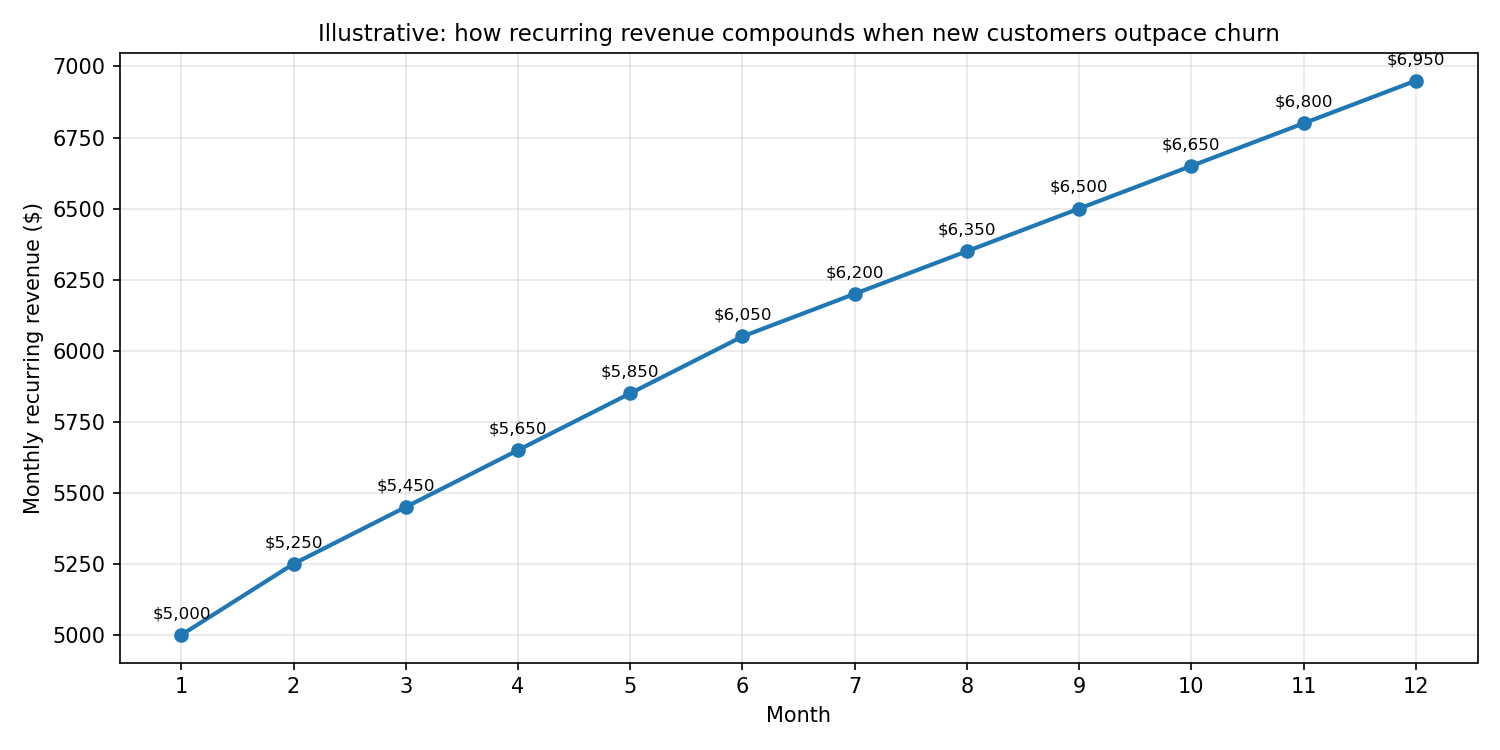
That is why retention sits at the heart of the model. A company that adds 100 customers and loses 90 of them has done far more work, for far less lasting revenue, than a company that adds 50 and loses 5.

Types of SaaS Revenue Model
Most SaaS products use one revenue model, or a mix of several. The choice shapes who signs up, how fast the company grows, and how much support customers need.
Subscription. The customer pays a fixed fee, monthly or annually, for access. This is the most common SaaS revenue model. Annual billing is common in business software because it improves cash flow and usually comes with a discount for paying upfront.
Freemium. A free plan with limits attracts users, and some upgrade to a paid plan for more features, users, or capacity. Freemium works when the product is easy to start without help and the free plan is useful enough to keep people around, but limited enough that growing teams need to pay.
Usage-based pricing. Customers pay for what they use, such as emails sent, API calls made, or gigabytes stored. This fits products where usage varies a lot between customers. It can be combined with a subscription, so a customer pays a base fee plus usage charges above an allowance.
Per-user and tiered pricing. The fee can be charged for each person who uses the product, which is simple to understand but can discourage customers from adding users. Or plans can be offered at different prices, with more features, users, or limits at each level, giving customers a clear upgrade path as they grow. Many companies combine two or more models, for example a free plan, tiered paid plans, and usage charges for heavy use.

Each of these is a pricing model as much as a revenue model, and the detail matters when you are choosing or comparing products. Our guide to SaaS pricing models explains each variant, with examples of when it fits and when it causes problems.
SaaS Sales Models: Low-Touch and High-Touch
Stripe’s guide to the business of SaaS makes a point first-time founders often miss: the sales model dictates almost everything else about a SaaS company, including the product, the team, and the cost structure.
Low-touch sales. The product is designed so most customers can buy it without sustained one-to-one contact with a salesperson. The main channels are the website, email, and a free trial, and the trial is built to be very low friction to start and to use. Customer success staff in low-touch companies focus on helping trial users onboard and convert, not on persuading them to buy. This model fits lower-priced products, where the cost of a sales call would be more than the first year’s revenue from the customer.
High-touch sales. A sales team works directly with each prospect, often over weeks or months, with demos, security reviews, and negotiated contracts. This model fits expensive products sold to large organisations, where a single deal can be worth tens of thousands of dollars a year. The cost is high, so the price has to be high enough to cover it.
The sales model also decides the team: a low-touch company invests in marketing, onboarding, and support, while a high-touch company invests in salespeople and implementation staff. Neither is better in general. The right one follows from the price and the buyer.
The SaaS Market
SaaS is a large and still growing part of the software industry. Gartner forecast worldwide end-user spending on SaaS, which it calls cloud application services, at $299.1 billion for 2025, up 19.2 percent from $250.8 billion in 2024, inside total public cloud spending of $723.4 billion. That figure is a forecast published in November 2024, not a measured result, and different firms define the market differently, so other estimates are higher. The direction is not in dispute: businesses keep moving everyday software, from email and CRM to accounting and HR, into the cloud.
That growth has also made the market crowded. Most categories now have several established products, and new entrants compete on a narrower slice of a problem, a specific industry, or a better experience. A vertical SaaS product, built for one industry such as dental practices or restaurants, is one common answer: it trades a smaller market for a product that fits its buyers more closely.
Unit Economics: The Numbers That Decide Whether SaaS Works
A SaaS business lives or dies on a small set of numbers. This section gives a short summary of each one. Our guide to key SaaS metrics covers them in full, with definitions, formulas, and benchmarks.
Gross margin. This is the share of revenue left after the direct cost of delivering the service, such as hosting, third-party software, and support. KeyBanc and Sapphire reported a median of about 78 percent in their 2024 survey, and other surveys put the typical range at roughly 70 to 85 percent. Figures were checked in November 2026 and vary by segment, so treat them as typical ranges, not promises.
Customer acquisition cost (CAC). This is what it costs, in sales and marketing spending, to win one new customer: acquisition spending in a period divided by the number of new customers won in that period.
Lifetime value (LTV). This is the gross profit a customer is expected to generate over the whole time they stay: average monthly revenue per customer multiplied by gross margin, divided by the monthly churn rate.
LTV to CAC ratio. This compares lifetime value with acquisition cost. A ratio of 3 to 1 is the widely quoted target, from investor guidance by David Skok and by Bessemer Venture Partners, which recommends investing in acquisition when the ratio is 3 times or better, measured on gross margin. A ratio below 1 means the lifetime gross profit does not cover the cost of winning the customer.
CAC payback period. This is how many months it takes for a customer’s gross profit to cover the cost of acquiring them. Skok recommends 12 months or less, and Bessemer’s guidance runs to under 12 months for small-business products, under 18 for mid-market, and under 24 for enterprise.
Return on investment (ROI). For a buyer, the return on a SaaS purchase is the value the software creates, in time saved, revenue gained, or costs avoided, compared with what it costs. Count implementation and training time as part of the cost, and base the value on the buyer’s own numbers, not on a vendor’s marketing page. A simple ROI calculator can do the arithmetic, but the value estimate is the hard part.
Churn and retention. Churn is the share of customers or revenue lost in a period. ChartMogul’s data shows how much churn varies by price: median monthly customer churn was 6.1 percent for accounts paying under $25 a month and 2.2 percent for accounts paying over $500 a month.
Together, these numbers answer the one question that matters: does each customer, over their lifetime, return more than they cost to win and serve?
How a SaaS Company Is Organised
A SaaS company’s structure follows its sales model and its stage. A small, self-serve company may have a handful of people covering product, engineering, marketing, and support. A larger company adds separate teams for sales, customer success, and partnerships.
The teams most SaaS companies end up with are product and engineering, marketing, sales, customer success, and support. In a low-touch company, customer success and support carry more of the work. In a high-touch company, sales and implementation carry more of it.
How to Scale a SaaS Business
Scaling a SaaS business means growing revenue faster than costs. The model helps, because serving one more customer on the same software costs far less than building the software in the first place. But scaling is not automatic.
First, the product has to solve a real problem for a defined group of buyers. Second, onboarding has to get new users to value quickly: the time between signing up and getting a meaningful result is one of the strongest predictors of whether a customer stays. Third, retention has to be measured and worked on deliberately, through customer success, product improvements, and pricing that grows with the value delivered.
Only after those three are working does it make sense to spend heavily on acquiring customers. Spending on acquisition before retention is fixed means paying to fill a leaking bucket. The same applies to pricing: raising prices before customers see the value will raise churn.

Benefits of the SaaS Business Model
For customers, the benefits are low upfront cost, no installation or maintenance, access from anywhere, and the ability to cancel if the product stops fitting. For the vendor, the benefits are recurring and predictable revenue, a direct relationship with every customer, and the ability to improve the product for all customers at once. The model aligns incentives: the vendor only keeps earning if the customer keeps finding the product valuable.
Risks and Downsides
The model has real risks. Churn is the first: a small rise in the monthly churn rate compounds into a large loss of customers over a year. Security and downtime are the second: an outage or a breach damages trust across the whole customer base at once. Vendor lock-in is the third, for customers: moving products can mean migrating data, retraining staff, and rebuilding integrations. Heavy discounting can also leave a company with revenue that does not cover its costs. None of these risks makes the model a bad choice. They make it one that needs attention to retention, security, and unit economics.
Is a SaaS Business Profitable?
A SaaS business can be profitable, but it is rarely profitable quickly. The company spends money upfront to build the product and win customers, and earns it back gradually, month by month, as customers stay. That gap is why many SaaS companies lose money in their early years even while revenue grows.
Profitability depends on the same numbers covered above: a high gross margin, a low cost to win customers relative to their lifetime value, a short payback period, and low churn. A company with those numbers in place can become profitable as it grows, because each new customer adds more than they cost. A company without them will lose more money the faster it grows.
That is also why investors look at SaaS companies differently: they weigh recurring revenue, retention, and growth together, rather than profit alone, and value companies on multiples of revenue or ARR. Our guide to SaaS company valuation multiples explains how those multiples work. If you are thinking of buying or selling a SaaS business rather than building one, our guide to how to sell a SaaS business covers the process, including what buyers check before they make an offer.
SaaS vs PaaS vs IaaS in One Paragraph
SaaS is one of three cloud service models. With infrastructure as a service, you rent raw computing resources and manage the operating system and applications yourself. With platform as a service, you get a managed environment to build and run your own applications. With SaaS, you get a finished application and manage almost nothing except your users and your data. The right choice depends on whether you need to use software, build software, or run infrastructure. Our comparison of SaaS vs PaaS vs IaaS covers the differences in full.
Examples of SaaS Business Models
Real products show how flexible the model is. Salesforce sells CRM software to businesses on a per-user subscription. Microsoft 365 sells productivity software as a subscription for individuals and businesses. Slack sells team communication on tiered plans, with a free plan for small teams. Shopify sells an ecommerce platform to merchants on tiered subscriptions, plus transaction and app fees.
The pattern is the same in each case: a recurring fee, a product the vendor runs, and a customer who pays for continued access. The differences are in the price, the buyer, and the sales model.

When the SaaS Model Fits, and When It Does Not
The model fits when customers need the software repeatedly, when the vendor can run one version for many customers, and when the value renews over time. Email, CRM, accounting, and team chat all fit that shape.
It fits less well when the software is used once or rarely, when each customer needs a very different version, or when data cannot leave their own systems.
Frequently Asked Questions
What is a SaaS business model in simple terms?
It is a model where a company hosts software in the cloud and customers pay a recurring fee, usually monthly or yearly, to use it, instead of buying a licence once and installing it themselves.
How do SaaS companies make money?
They earn recurring revenue from subscriptions. Revenue grows through new customers, customers who stay, and existing customers who upgrade or add users.
Is SaaS profitable?
It can be, but usually not quickly. A SaaS company spends money upfront to build the product and win customers, and earns it back over the months those customers stay.
What are examples of SaaS companies?
Salesforce, Microsoft 365, Slack, Shopify, and Adobe are well-known examples, each selling software as a subscription, hosted and run by the vendor.
What is MRR in a SaaS business?
MRR, or monthly recurring revenue, is the subscription revenue a company can expect each month from its current customers. ARR is the same idea over a year.
What is the difference between SaaS, PaaS, and IaaS?
SaaS delivers a finished application. PaaS delivers a managed platform for building applications. IaaS delivers raw computing resources such as virtual servers and storage.
How do I start a SaaS business?
Start with a problem that a defined group of buyers already pays to solve, build the smallest product that solves it well, get paying customers before adding features, and measure retention from the start.
Watch: The SaaS Business Model Explained
What Is SaaS? How Software Companies Actually Make Money — The Tech Decision
A clear explainer covering what SaaS means, recurring revenue, MRR and ARR, and freemium, subscription, and usage-based pricing. Checked live on 23 Nov 2026.
The Economics of Own a Software Company — YouTube
A walkthrough of how a SaaS business works, built around CAC, LTV, and churn, with illustrative numbers for a fictional founder. Checked live on 23 Nov 2026.
Sources
9
- US National Institute of Standards and Technology, “The NIST Definition of Cloud Computing”, Special Publication 800-145 (Sep 2011) — https://doi.org/10.6028/NIST.SP.800-145
- Microsoft Azure, “What is Software as a Service (SaaS)?” — https://azure.microsoft.com/en-us/resources/cloud-computing-dictionary/what-is-saas/
- Stripe, “SaaS business model: How do SaaS businesses work?” — https://stripe.com/ie/guides/atlas/business-of-saas
- Salesforce, “What is SaaS (Software as a Service)?” — https://www.salesforce.com/saas/
- EltexSoft, “SaaS Statistics 2026” (reporting Gartner’s November 2024 forecast) — https://eltexsoft.com/blog/saas-statistics/
- Fourward, “Average Churn Rate for SaaS Companies: 2026 Benchmarks” (reporting ChartMogul figures) — https://www.fourwardhq.com/blog/average-churn-rate-for-saas-companies/
- Breaking B2B, “SaaS Benchmarks 2026” (reporting KeyBanc and Sapphire figures) — https://www.breakingb2b.com/blog/saas-benchmarks
- TrackRev, “LTV to CAC Ratio: Formula, Benchmarks and Payback” (reporting Skok and Bessemer guidance) — https://www.trackrev.io/blog/ltv-to-cac-ratio
- Search Engine Land, “Google publishes guide on optimizing for generative AI features” (15 May 2026) — https://searchengineland.com/google-publishes-guide-on-optimizing-for-generative-ai-features-477671
Every factual claim on this page was verified against a named source above.