


AI news is reporting on artificial intelligence: new models, products, research, company moves, regulation, and what it all means for the people who use the technology. This page is the hub for it. It explains what AI news covers, the topics worth following, where to read it, and how to judge a story before you believe it.
What Is AI News?
Artificial intelligence is technology that lets computers simulate human learning, comprehension, problem solving, decision making, creativity, and autonomy, in IBM’s definition. AI news is simply the reporting of what happens in that field, day by day.
It covers more than new chatbots. A model release, a research paper, a funding round, a lawsuit, a new law, a chip shortage, and a hospital trial of an AI diagnostic tool are all AI news. What they share is that they change what AI can do, who controls it, or how it affects ordinary people.
The field went mainstream in late 2022. OpenAI released ChatGPT as a free research preview on 30 November 2022, built on a model from the GPT-3.5 series. About two months later, a UBS study estimated it had reached 100 million monthly users in January 2023, the fastest growth of any consumer app on record at the time. Since then, AI has stayed on the front page, and the volume of coverage has only grown.
That is why this page exists as a hub rather than a list of headlines. Headlines rot within days. The topics, the sources, and the judgment skills on this page stay useful for months.
Why AI News Moves So Fast
AI news moves fast because the field itself moves fast. Research output is the clearest sign. The arXiv preprint server’s artificial intelligence listing regularly carries hundreds of new papers on a single busy day, and most of them have not been peer reviewed yet. A result can go from a paper to a product demo to a headline in the same week.
Companies add to the pace. The big labs announce models, features, and partnerships on their own blogs, often with little warning, and rivals answer within days. Trade shows such as CES in January are when many companies time their AI announcements, so the latest AI news in 2026, like every year, arrived in a flood at the start of the year.

The speed creates a problem for readers. A claim that sounds certain in the morning can be corrected, walked back, or overtaken by evening. That is why recent AI news is best read with a routine and a short list of trusted sources, not by refreshing a feed all day. The pace is also why a search for AI news today returns a different front page every morning. The sections below give you both the routine and the list.
The Big Topics in AI News Today
AI news is not one story. It is several beats that run at the same time, and each one has its own sources and its own jargon. These are the ones that produce the most news.
New models and research. The labs publish new models and the papers behind them. This is where terms such as large language models, multimodal models, and open-weight releases come from. Benchmark scores get quoted in headlines, but a benchmark is a single test, not a verdict.
AI agents and automation. Agents are AI systems that take actions on your behalf, such as booking travel, writing code, or running a business process. AI automation news follows how companies put agents to work, and where they fail. This is one of the fastest-growing parts of the field, and one of the most hyped.
Chips and computing power. Every model runs on hardware, and the supply of advanced chips shapes who can build what. News here covers chip launches, data center builds, energy use, and export controls.
Companies and money. Funding rounds, acquisitions, IPOs, partnerships, and layoffs. The business beat explains who is winning, who is spending, and what investors expect.
Regulation, safety, and ethics. Laws, court cases, safety research, and arguments about what AI should and should not be allowed to do. This beat moves slower than product news and matters more in the long run.
AI in everyday industries. Health, education, finance, retail, manufacturing, and media all have their own AI stories now, from diagnostic tools to classroom policy.
Company news from the big labs and tech firms. OpenAI, Google, Microsoft, Meta, Amazon, Apple, NVIDIA, and Anthropic generate most of the headlines between them. Our AI company news hub tracks them lab by lab.

Browse the AI News Hub
This pillar page sits above a set of focused hubs. Each one goes deep on its own beat, so this page only summarises them. Start here, then follow the beat you care about.
AI Technology News
The general technology beat: new models, features, and products as they land, plus the weekly roundup that collects the most important stories. If you want the top AI news today, or one place to catch the latest AI news each week, start with our AI technology news hub.
Best AI News Sites and Newsletters
You do not need fifty sources. A short list of newsrooms, lab blogs, and newsletters covers almost everything, and this guide names them and explains what each one is good for. See our guide to the best AI news sites and newsletters.
The rest of the hub, by beat:
- AI company news: the big labs and tech firms, lab by lab: AI company news.
Where to Follow AI News
The best AI news diet mixes three kinds of source. No single one is enough.
The labs themselves, first. Announcements break on the company blogs of OpenAI, Google DeepMind, Anthropic, Meta, and Microsoft. Read the announcement before the commentary about it. It is the only version that is not filtered through someone else’s summary, and it usually links to the paper, the demo, or the safety notes.
Newsrooms with an AI desk. The Verge’s AI section covers products, policy, and culture in plain language. TechCrunch’s AI section covers launches, startups, and funding the day they happen. MIT Technology Review’s AI topic goes slower and deeper, with research context other outlets skip. The Register’s AI and ML section is a good check on the enterprise and infrastructure side. A general news wire such as Reuters covers the stories that cross into business, politics, and law.
Research, in the raw. arXiv’s artificial intelligence listing is where papers appear first, before any journalist has written about them. You do not need to read the papers. Skimming the titles each morning tells you what researchers are working on weeks before it reaches the press. Two Minute Papers on YouTube does the same job in video form, turning one paper at a time into a short explainer.
Newsletters and RSS feeds tie the mix together. Most of the outlets above publish RSS feeds, and a feed reader lets you scan headlines from all of them in one place instead of visiting ten sites. Pick one daily newsletter for the headlines and one weekly one for analysis, and let the rest go.
How to Tell Good AI News from Hype
AI is the most hyped field in technology, and the hype follows a pattern. A press release makes a big claim, a dozen outlets repeat it, and the caveats appear days later, if at all. A short checklist catches most of it.
Look for the primary source. A good story links to the paper, the blog post, the filing, or the law it is reporting on. If a story about a breakthrough links to nothing but other news stories, treat the claim as unverified.
Read benchmark claims with care. “Beats the leading model on this test” is a narrow claim. Ask which test, who ran it, and whether anyone independent repeated it. A single benchmark result is not proof that a model is better in general.
Check the date. AI news goes stale fast. A model that was state of the art six months ago may be two generations behind now. If a story has no date, or the date is missing from a search result, find the original announcement before quoting it.
Watch for AI-generated fakes. The same technology that makes the news also makes convincing fake images, audio, and video. In the US, the Federal Trade Commission’s impersonation rule, in force since 1 April 2024, makes it unlawful to falsely pose as a government agency or a business, including with AI-generated deepfakes. If a clip shows a public figure saying something surprising, check whether a reputable outlet has confirmed it before sharing it.
Separate the demo from the product. A staged demo shows what a system did once, under controlled conditions. A shipped product shows what it does every day. The gap between the two is where most AI disappointments live.

AI Regulation and Safety: The Rules Behind the Headlines
Regulation is the slowest beat in AI news and the one with the longest consequences. Two frameworks shape most of the headlines.
The European Union’s AI Act is the world’s first comprehensive AI law. It entered into force on 1 August 2024 and applies in stages. Its banned practices, such as social scoring, have applied since February 2025. Rules for general-purpose AI models have applied since August 2025. Transparency duties, such as telling people when they are dealing with AI, apply from August 2026, and the strict rules for high-risk systems follow from December 2027. Fines for banned practices can reach 35 million euros or 7 percent of worldwide annual turnover, whichever is higher.
In the United States there is no single AI law. The closest thing to a shared standard is the National Institute of Standards and Technology’s AI Risk Management Framework, released on 26 January 2023. It is voluntary guidance, organised around four functions: govern, map, measure, and manage. It is the document most often cited when companies and agencies explain how they handle AI risk.

Safety news sits alongside regulation. It covers research into how models fail, how they can be misused, and what limits labs place on them. It also covers the arguments about whether development should slow down, speed up, or be steered in a particular direction. Read safety claims the same way as product claims: look for the paper or the test behind them.
How AI News Reaches You
Most people no longer go looking for AI news. It finds them, through search, social feeds, and newsletters. Understanding that chain helps you judge what you see.
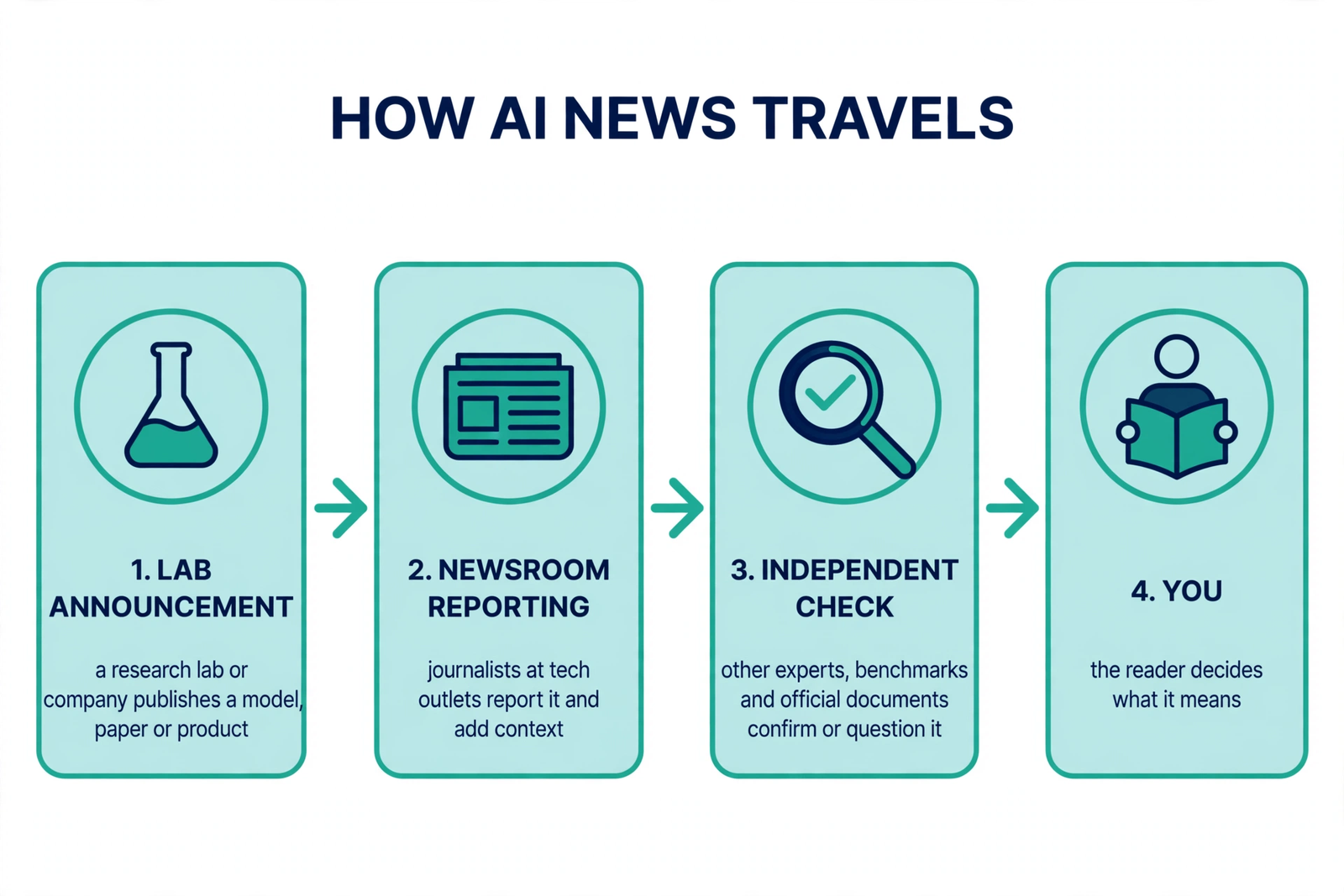
Search itself has changed how AI news spreads. Google launched AI Overviews in the United States on 14 May 2024, putting AI-generated summaries at the top of search results. That means many people now read a summary of the news before they read the news itself, and summaries can and do make mistakes. Google’s own help pages say so. When a summary matters, click through to the source it cites.
The practical rule is simple. Trust a story more when you can see each step of the chain: the announcement, the reporting, and an independent check. Trust it less when you only see the last step.
How to Keep Up Without Drowning
Nobody can follow all of AI news. The people who stay informed follow a routine, not a feed.
Scan daily, read weekly. Spend ten minutes a day on headlines from one newsroom and one lab blog. Spend an hour a week on one long piece, such as an MIT Technology Review analysis or a research explainer. The daily scan tells you what happened. The weekly read tells you what it means.
Follow beats, not everything. Pick two beats from the list above that match your work or your interests, and follow their hubs on this site. Ignore the rest until you need it. A developer needs model and tool news. A manager needs business and regulation news. A student needs research news.
Keep a short source list. One lab blog, one newsroom, one research source, and one newsletter. Add a source only when it repeatedly tells you something your list missed. Delete one when it only repeats the others.
Check the date before you share. A story from last year about a model’s limits, a law’s timeline, or a company’s plans is probably wrong now. Our weekly roundup in the AI technology news hub is the easiest way to stay current without checking every day.

Watch: AI News, Explained on Video
1. “AI vs Machine Learning” (IBM Technology)
A short explainer, about 6 minutes, on the difference between AI, machine learning, and deep learning, and how the terms fit together. Useful background before reading AI news, because headlines mix these terms up constantly.
2. “But what is a neural network? | Deep learning chapter 1” (3Blue1Brown)
An 18-minute visual explainer on what a neural network actually is, using a network that reads handwritten digits. It is the clearest introduction to the technology behind most of today’s AI news.
Frequently Asked Questions
What is AI news?
AI news is reporting on artificial intelligence: new models, products, research, company moves, regulation, and safety. It covers anything that changes what AI can do, who controls it, or how it affects people.
Where can I get the latest AI news today?
Start with the labs’ own blogs for announcements, then a newsroom with an AI desk such as The Verge, TechCrunch, or MIT Technology Review for reporting. A daily newsletter or an RSS reader ties them together. Our guide to the best AI news sites and newsletters names the short list.
What is the biggest AI story of recent years?
The launch of ChatGPT on 30 November 2022. It took a technology that had lived in research labs and put it in front of the general public, and it reached an estimated 100 million monthly users within about two months. Most of the AI news since then follows from that moment.
How do I keep up with AI news without spending all day on it?
Scan headlines for ten minutes a day from one newsroom and one lab blog, and read one long piece a week. Follow two beats that match your work, and let the rest go. A weekly roundup, such as the one in our AI technology news hub, covers what you missed.
Is AI news reliable?
Some of it is, some of it is not. Good AI news links to a primary source, names its tests, and carries a date. Treat benchmark claims, demo videos, and anonymous rumours with care, and check whether a second independent source confirms a big claim before you act on it.
What is the EU AI Act?
The EU AI Act is the world’s first comprehensive law on artificial intelligence. It entered into force on 1 August 2024 and applies in stages, with bans in force since February 2025, rules for general-purpose AI models since August 2025, transparency duties from August 2026, and high-risk rules from December 2027.
What is the difference between AI news and AI research news?
AI news covers the whole field, including products, companies, and regulation. AI research news is one beat inside it: papers, models, and benchmarks.
How can I tell if an AI story is fake?
Check whether a reputable outlet has confirmed it, look for the primary source, and check the date. AI-generated images, audio, and video are now convincing enough to fool a casual look, and the FTC’s impersonation rule exists precisely because deepfake scams have become common.
The Bottom Line
AI news is a fast-moving field, but it rewards a slow routine: a short list of trusted sources, two beats that match your work, and a habit of checking the primary source before you believe a claim. The headlines will change every day. The way to read them does not have to. Start with the AI technology news hub for the latest stories, and use the rest of this hub to go deeper on the beat you care about.
Sources
12
- IBM, “What Is Artificial Intelligence (AI)?”, https://www.ibm.com/think/topics/artificial-intelligence
- OpenAI, “Introducing ChatGPT” (30 November 2022), https://openai.com/index/chatgpt/
- Reuters (via Indian Express), “ChatGPT sets record for fastest-growing user base” (1 February 2023), https://indianexpress.com/article/technology/chatgpt-sets-record-for-fastest-growing-user-base-8419389/
- European Commission, “AI Act”, https://digital-strategy.ec.europa.eu/en/policies/regulatory-framework-ai
- US National Institute of Standards and Technology, “NIST Risk Management Framework Aims to Improve Trustworthiness of Artificial Intelligence” (26 January 2023), https://www.nist.gov/news-events/news/2023/01/nist-risk-management-framework-aims-improve-trustworthiness-artificial
- eCFR, “Rule on Impersonation of Government and Businesses” (16 CFR Part 461), https://www.ecfr.gov/current/title-16/chapter-I/subchapter-D/part-461
- Google, “Google I/O 2024: New generative AI experiences in Search” (14 May 2024), https://blog.google/products-and-platforms/products/search/generative-ai-google-search-may-2024/
- arXiv, “Artificial Intelligence” (recent submissions), https://arxiv.org/list/cs.AI/recent
- MIT Technology Review, “Artificial Intelligence” topic, https://www.technologyreview.com/topic/artificial-intelligence/
- The Verge, “AI”, https://www.theverge.com/ai-artificial-intelligence
- TechCrunch, “AI News & Artificial Intelligence”, https://techcrunch.com/category/artificial-intelligence/
- The Register, “AI and ML news”, https://www.theregister.com/ai_ml
Checked 23 Nov 2026. Every factual claim on this page was verified against a named source above.