By Tech Success Communications Editorial Team | Checked 23 Nov 2026

B2B SaaS is cloud software that one business builds, hosts, and sells to other businesses on a recurring subscription. Instead of buying a license and installing software on its own computers, a company logs in through a browser and pays monthly or annually for access.
If you are new to the wider topic, start with our guide to SaaS software.
What Does B2B SaaS Mean?
The term joins two ideas. B2B stands for business-to-business: the buyer is a company, not an individual shopper. SaaS stands for software as a service: the software is delivered as a hosted service and paid for as a subscription, instead of being sold once as a license and installed on the customer’s own computers.
The U.S. National Institute of Standards and Technology (NIST) defines software as a service as the capability to use the provider’s applications running on cloud infrastructure. The applications are reached through a browser or a program interface, and the customer does not manage or control the underlying cloud infrastructure, including network, servers, operating systems, or storage.
Three traits define every B2B SaaS product: a business buyer, a recurring subscription, and cloud delivery. The vendor runs the servers, ships the updates, and stores the data. The customer signs in and uses the software. IBM puts it the same way: SaaS is a cloud-based delivery model in which providers host applications and make them available to users over the internet, and the vendor is responsible for provisioning, managing, and maintaining the servers and infrastructure.
The other half of the SaaS market sells to individual consumers rather than companies. That side works differently, from pricing to sales, and our guide to B2B vs B2C SaaS covers the full comparison.
How Does B2B SaaS Work?
A B2B SaaS product follows the same flow every time: the vendor builds and hosts the software, the cloud runs it, and the customer subscribes and logs in.
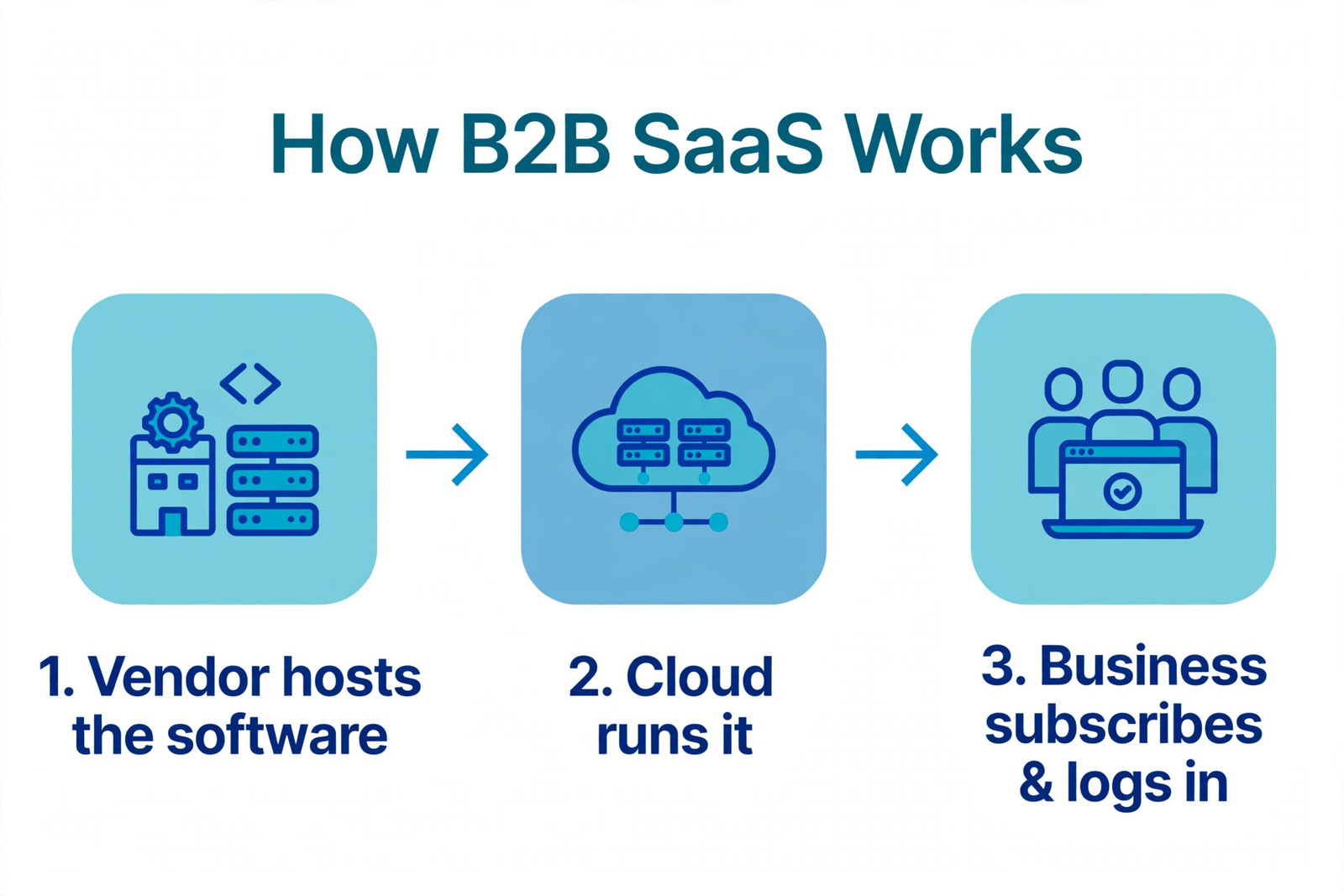
- The vendor builds and hosts the software. It runs on the vendor’s own cloud infrastructure or on a public cloud.
- The customer subscribes. The business pays a recurring fee, usually monthly or annually, and creates accounts for its team.
- The team logs in. Staff open the software in a browser or an app. There is nothing to install, and updates arrive automatically.
Most B2B SaaS products are multi-tenant, which means one running copy of the software serves many customers at once. IBM explains that a single instance of a software application, with its underlying database and hardware, serves multiple tenants, while each tenant’s data, user data, and custom settings are kept separate from other customers. Some large customers get a dedicated instance instead, a setup the AWS SaaS Architecture Fundamentals whitepaper describes as a silo, as opposed to a shared pool.
The split of responsibilities is the point of the model. The vendor handles hosting, security patches, backups, and upgrades. The customer handles its own accounts, permissions, and data, and connects the product to its other tools. Integrations matter here: B2B SaaS products connect to other business software through APIs, so a CRM can pass data to an accounting system or a marketing tool without manual retyping.
B2B SaaS Examples by Category
Almost every department in a company now runs on B2B SaaS. The examples below are grouped by the job the software does.
| Category | What it does | Well-known examples |
|---|---|---|
| CRM | Tracks customers, deals, and sales pipelines | Salesforce, HubSpot, Pipedrive |
| Project management | Organises tasks, deadlines, and team work | Asana, Monday.com, Jira |
| Communication | Team chat, video meetings, and calls | Slack, Zoom, Microsoft Teams |
| Accounting | Invoicing, expenses, and bookkeeping | QuickBooks Online, Xero, FreshBooks |
| HR and payroll | Hiring, pay, and employee records | Workday, BambooHR, Gusto |
| Engineering and IT | Monitoring, workflows, and code | Datadog, ServiceNow, GitHub |

A typical company uses several of these at once: a CRM for sales, a chat tool for the team, and an accounting tool for finance.
For a longer list across every category, see our SaaS examples.
Top B2B SaaS Companies
The companies below are among the best known in B2B SaaS. They are listed in alphabetical order, not ranked, because no single list can rank products built for different jobs.
- Atlassian makes Jira and Confluence, team tools for planning work and sharing knowledge.
- HubSpot combines customer relationship management (CRM), marketing automation, sales tools, and customer support in one platform.
- Salesforce is the CRM company most often credited with popularising the model. Salesforce says it pioneered cloud-based CRM in 1999.
- ServiceNow sells IT service management and enterprise workflow automation.
- Shopify is a commerce platform that lets merchants run an online store, checkout, and point of sale.
- Slack is a team chat and collaboration tool, now part of Salesforce.
- Zoom provides video meetings, phone, and webinars for businesses.
What these companies share is the model, not the product: each one sells to businesses, hosts its own software, and charges a subscription.
Built for One Industry or for Every Industry
B2B SaaS products split into two kinds. Horizontal SaaS does one job for companies in any industry: CRM, accounting, chat, and project management are horizontal. Salesforce and Slack are horizontal products, and the market is large, but so is the competition.
Vertical SaaS is built for one industry and covers many of its jobs. Toast serves restaurants, Veeva serves life sciences, and Procore serves construction. The market is smaller, but deep industry knowledge makes the product harder to copy and harder to leave. Our guide to vertical SaaS explains how these products work in detail.
A horizontal tool fits a company that wants a proven product for a common job. A vertical tool fits a company whose work follows one industry’s rules.
How B2B SaaS Companies Charge
Every B2B SaaS company charges a subscription, but what the subscription is based on varies. Most companies combine two or more of these models.
| Pricing model | How customers pay | Examples |
|---|---|---|
| Per seat | A fee for each user | Slack, Asana, Zoom |
| Usage-based | By consumption, such as API calls or data | Twilio, Snowflake, Datadog |
| Tiered | Packages with rising features and limits | HubSpot, Semrush |
| Flat rate | One price, unlimited users | Basecamp |
| Freemium | A free plan, with paid upgrades | HubSpot free CRM, Slack free plan |

Prices vary widely by product, plan, and company size, and they change often, so check the vendor’s own pricing page before budgeting. The model matters more than any single price: per-seat pricing grows with headcount, usage-based pricing grows with activity, and freemium plans let a team try the product before paying.
Benefits of B2B SaaS
For the business buying the software, the appeal is practical.
- Low upfront cost. There are no servers to buy and no licenses to pay for in advance. Spending shifts from a large one-off purchase to a monthly operating cost.
- Fast start. A team can sign up and start work the same day, instead of waiting weeks for installation and setup.
- Always up to date. Updates and security patches arrive automatically, so nobody has to schedule an upgrade.
- Access from anywhere. Staff log in from the office, home, or on the road, on any device with a browser.
- Easy to scale. Adding a new hire usually means adding a seat, not buying more hardware.
- Connected tools. Integrations and APIs let the CRM, accounting, and marketing tools share data.

The Downsides
The model has real trade-offs, and they are worth weighing before signing a contract.
- The cost never ends. A subscription is a permanent bill. Over several years, renting can cost more than buying once would have.
- Your data lives on someone else’s servers. You trust the vendor’s security, uptime, and data practices.
- Stop paying, lose access. If the subscription lapses, the software and often the data inside it become unavailable.
- Internet required. Most B2B SaaS products need a connection to work at all.
- Switching is painful. Moving years of records, workflows, and integrations to a rival product takes time and money, which is why vendors work hard to keep customers.
None of these is a reason to avoid B2B SaaS. They are reasons to read the contract and check the vendor’s security and export options before committing a whole team.
Who Buys B2B SaaS, and How They Decide
B2B SaaS is bought by teams, not by one person. A purchase usually involves the people who will use the software, a manager who owns the budget, and reviewers from IT and finance who check security, data handling, and cost. That is why B2B sales cycles run longer than consumer purchases: the decision carries more risk and a longer commitment.

For small teams the process can take days: a free trial, a quick comparison, and a card payment. For large companies it can take months, with demos, security reviews, procurement, and legal negotiation. Vendors reach these buyers through content, trials, demos, and sales teams, as our guide to SaaS marketing strategy explains.
Related reading: What is a SaaS company? Our guide explains what makes a company a SaaS company. Is Salesforce, Microsoft 365 or Google Workspace SaaS? Answers the question for three products everyone knows. What does SaaS stand for? Covers the acronym and the history behind it.
Watch: What Is SaaS?
What Is SaaS? (Explained in 5 Minutes) — Dan Martell
A five-minute explainer on the subscription model, remote hosting, online access, and regular updates behind SaaS. The channel is a SaaS founder’s channel, and the video description links to his own products. Checked live on 23 Nov 2026.
Building a SaaS with AI? 5 Technical Decisions You Can’t Skip — 5 Minutes Tech
Frequently Asked Questions
What does B2B SaaS mean?
The B2B SaaS meaning is business-to-business software as a service: cloud software that one business sells to other businesses on a recurring subscription. The buyer is a company, the software is hosted by the vendor, and the customer pays for access instead of owning a copy.
What is a B2B SaaS company?
A B2B SaaS company is a business whose product is software sold to other businesses as a hosted subscription. Salesforce, HubSpot, Slack, Zoom, and Shopify are B2B SaaS companies. The company builds the software, runs it in the cloud, and charges customers monthly or annually to use it.
What are some B2B SaaS examples?
Common examples by category are Salesforce and HubSpot for CRM, Slack and Zoom for communication, Asana and Monday.com for project management, QuickBooks Online and Xero for accounting, and Workday for HR and payroll.
How do B2B SaaS companies make money?
They charge subscriptions. The usual models are per seat, usage-based, tiered packages, flat-rate pricing, and freemium plans with paid upgrades. Most companies combine two or more of these.
What does a B2B SaaS writer do?
A B2B SaaS writer writes content for B2B SaaS companies: product guides, help documentation, blog posts, case studies, and landing pages that explain the software to business buyers.
Is B2B SaaS the same as cloud software?
They overlap but are not the same thing. Cloud software is any software delivered over the internet from remote servers. B2B SaaS is a specific kind: software sold to businesses on a subscription, with the vendor running the whole service.
Do you need to install B2B SaaS software?
No. B2B SaaS products run in a browser or a mobile app, and the vendor hosts the software. There is nothing to install on company servers, and updates arrive automatically.
The Bottom Line
B2B SaaS is software rented, not bought: a vendor hosts it in the cloud, a business subscribes, and its team logs in from anywhere. The model works because it removes servers, installation, and upgrades from the buyer, and it earns its keep when the product solves a real job at a fair price. For the background on the model itself, see what SaaS is.
Sources
9
- U.S. National Institute of Standards and Technology (NIST), Special Publication 800-145, “The NIST Definition of Cloud Computing” (September 2011) — https://doi.org/10.6028/NIST.SP.800-145
- IBM, “What Is Software as a Service (SaaS)?” — https://www.ibm.com/think/topics/saas
- IBM, “What Is Multi-Tenant?” — https://www.ibm.com/think/topics/multi-tenant
- Amazon Web Services (AWS), “SaaS Architecture Fundamentals” whitepaper (August 2022) — https://d1.awsstatic.com/onedam/marketing-channels/website/aws/en_US/events/approved/documents/saas-architecture-fundamentals-whitepaper.pdf
- Salesforce, “What is Salesforce?” — https://www.salesforce.com/products/what-is-salesforce/
- Salesforce, “What Is CRM (Customer Relationship Management)?” — https://www.salesforce.com/crm/what-is-crm/
- FounderPath, “What Is B2B SaaS? Definition, Examples & How to Build One” — https://founderpath.com/blog/b2b-saas
- Ramotion, “What is B2B SaaS?” — https://www.ramotion.com/blog/what-is-b2b-saas/
- DealHub, “What is B2B SaaS?” — https://dealhub.io/glossary/b2b-saas/
Checked 23 Nov 2026. Every factual claim on this page was verified against a named source above. No prices are quoted because vendor pricing changes often; check the vendor’s own pricing page.