
By Tech Success Communications Editorial Team | Checked 23 Nov 2026

A SaaS company is a company that builds software and delivers it over the internet on a subscription, instead of selling a copy you install on your own computer. Customers sign in through a browser or app, and the company runs the hosting, updates and security behind the scenes.
You already use SaaS companies every day. Gmail, Slack, Zoom and Netflix are all software you open in a browser or an app and pay for by the month, rather than software you buy once and install. Our guide to SaaS software explains the product side; this page explains the company behind it.
SaaS Company Meaning and Definition
SaaS stands for Software as a Service. The U.S. National Institute of Standards and Technology (NIST) defines it as the ability to use a provider’s applications running on cloud infrastructure, reached through a web browser or a program interface, while the customer does not manage the underlying servers, storage or operating systems.
Put simply, a SaaS company sells access to software, not the software itself: the customer pays for an ongoing service, and the company keeps that service running.
A company counts as a SaaS company when it meets three tests. First, it delivers its software over the internet. Second, customers pay for it on a recurring basis, usually monthly or yearly. Third, the company itself hosts and maintains the software, so the customer never installs or updates it. A firm that sells boxed software once fails the first two tests.
How Does a SaaS Company Work?
A SaaS company builds one version of its software and runs it centrally, on servers in data centres it owns or rents. Every customer uses that same version, a setup called multi-tenant architecture, where many customers share one instance while their data stays separate.
For a customer, the flow is short: sign up and pick a plan, often starting with a free trial; sign in from any device with internet access; use the software while the provider’s servers do the work; and get every fix and new feature at once, with nothing to install.

The contrast with traditional software is the whole point. The diagram below shows the difference at a glance.
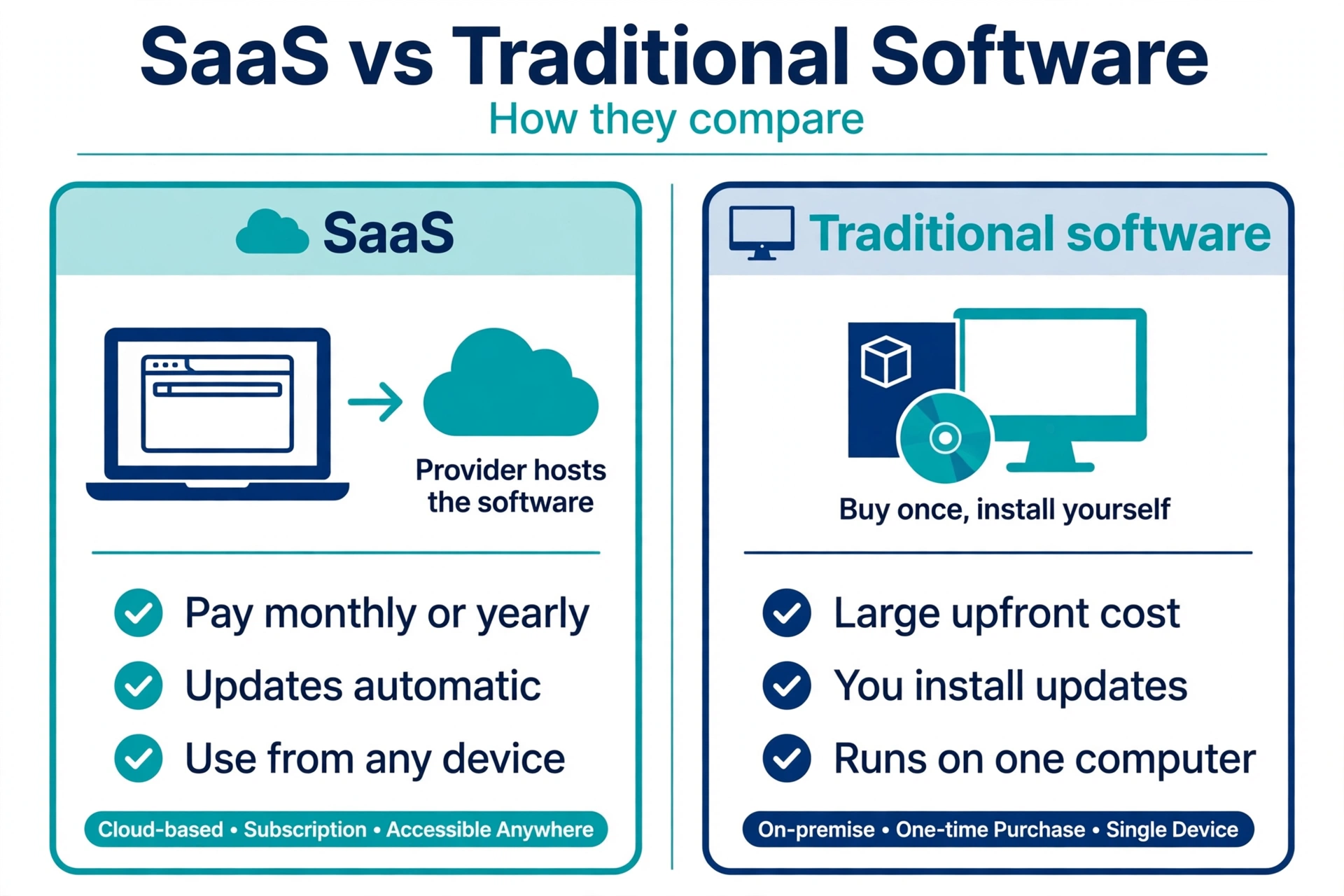
| SaaS company | Traditional software company | |
|---|---|---|
| How you get it | Sign in online | Buy and install a copy |
| How you pay | Monthly or yearly subscription | One-time purchase |
| Updates | Automatic, for everyone at once | You download and install them |
| Where it runs | The provider’s servers | Your computer |
| Where you use it | Any device with internet access | Usually one computer |
Two related models sell the building blocks underneath SaaS. Platform as a Service (PaaS) gives developers a platform to build applications on, and Infrastructure as a Service (IaaS) rents out servers and storage. A SaaS company sells finished software.
What a SaaS Company Does for Its Customers
A SaaS company takes on work that used to fall on the customer’s IT team.
- Hosting. It runs the servers, storage and network the software needs.
- Updates and fixes. It ships new features and security patches to every customer at once.
- Security. It protects customer data with encryption, access controls and monitoring.
- Backups. It keeps copies of customer data so a failure does not mean data loss.
- Support. It answers questions and helps new customers get started.
- Scaling. It adds capacity as customers grow.
Inside the company, that work is split across familiar departments: product and engineering build the software, sales and marketing win customers, and customer success and support keep them. Roles in a SaaS company range from developers and designers to sales staff, support agents and data analysts.

Types of SaaS Companies
SaaS companies come in a few broad types. Business to business (B2B) companies sell to other businesses: Salesforce sells customer management to sales teams, and Slack sells messaging to companies. Our guide to what B2B SaaS means covers this type in full. Business to consumer (B2C) companies sell to individuals: Netflix sells streaming to households, and Dropbox sells storage to anyone with files to keep. Vertical SaaS serves one industry, such as software only for dentists or law firms. Horizontal SaaS is one general tool for many industries, such as accounting software. Micro SaaS is a small product, often run by a tiny team, that solves one narrow problem well.
How SaaS Companies Make Money
Most SaaS companies earn money from subscriptions. A customer pays a recurring fee, usually monthly or yearly, for access. The fee often depends on the number of users, the features included, or how much of the service is used.
Three pricing patterns cover most of the market:
- Flat subscription. One price per user per month.
- Freemium. A free basic version, with paying plans for extra features, storage or users.
- Usage-based. The bill grows with use.
Two numbers run a SaaS business: monthly recurring revenue (MRR), the subscription income expected in one month, and annual recurring revenue (ARR), the same figure over a year. Investors watch these closely, because recurring revenue is more predictable than one-off sales. For the full picture, see the SaaS business model and our guide to SaaS pricing models.
Examples of SaaS Companies
A short list shows how wide the category is. These are well-known names, not a ranking; a fuller list is in our SaaS examples guide, and the largest are in our guide to the biggest SaaS companies.
| Company | What it sells as a service |
|---|---|
| Salesforce | Customer relationship management (CRM) |
| Microsoft 365 | Word, Excel, Outlook and Teams in the cloud |
| Google Workspace | Gmail, Docs, Drive and Meet |
| Slack | Workplace messaging and collaboration |
| Zoom | Video meetings |
Salesforce, Microsoft 365 and Google Workspace all count as SaaS: each delivers software over the internet on a subscription. Our guide on whether Salesforce, Microsoft 365 and Google Workspace are SaaS works through each one.
A large technology company is not always a SaaS company, even when it sells SaaS products. Google and Microsoft both sell SaaS products, but they also earn money from advertising, devices and other businesses.
How to Evaluate a SaaS Company: A Checklist
If you are choosing a SaaS product, use this checklist before you sign up, and run the free trial properly: import a small sample of your real data, try your three most common tasks, and contact support with a real question.
| Check | What to look for |
|---|---|
| Does it solve your problem? | Write down your must-haves first, then compare the product against them, not its marketing page. |
| What does it really cost? | Add up per-user fees, storage, premium features and support tiers over one to three years. |
| Is your data safe? | Look for SOC 2 Type II, ISO/IEC 27001, encryption in transit and at rest, multi-factor authentication and single sign-on. |
| Can you get your data out? | Confirm you can export your data in a usable format, and ask what happens to it if you cancel. |
| Does it connect to your tools? | Check the integrations and the API against the systems you already use. |
| Will it stay online? | Look for a public status page with real incident history and a written uptime promise (SLA). |
| Is the vendor stable? | Check how long the company has operated and whether its roadmap is public. |
| What does the contract say? | Read the auto-renewal clause, the cancellation notice period, and any price rise clause. |

How SaaS Companies Are Valued
Buyers and investors usually value a private SaaS company as a multiple of its annual recurring revenue. A company with $2 million of ARR valued at 5 times ARR is worth about $10 million before cash and debt are counted. The multiple is not fixed: it rises with faster growth, higher net revenue retention (existing customers spending more over time) and stronger profit margins, and falls when growth slows or customers leave. In private transactions, multiples commonly range from about 3 times ARR for slow-growing companies to 8 to 12 times ARR for fast-growing ones with strong retention, according to FIH’s 2026 guide to software valuations.
One rule of thumb investors use is the Rule of 40: a company’s revenue growth rate plus its profit margin should reach at least 40. A company growing 30 percent with a 10 percent margin scores 40, and so does one growing 60 percent while losing 20 percent. Our guide to SaaS valuation multiples explains the method in full.
SaaS Companies for Small Business
Small businesses are some of the keenest SaaS customers, because the model removes costs they cannot carry: no servers to buy, no IT team to hire, no large upfront licence fee. A small team can start with one or two seats and add more as it grows. That is why software for small business is now mostly SaaS: accounting, invoicing, booking, email marketing and customer management all come as monthly subscriptions. Subscriptions add up, so count the total across every tool before committing.

Benefits and Drawbacks
| Benefits | Drawbacks |
|---|---|
| Lower upfront cost than buying software outright | Monthly fees add up over years |
| Always on the latest version, with no installs | Needs an internet connection to work |
| Usable from any device, anywhere | Less control and customisation than software you run yourself |
| Scales up or down as the team changes size | Your data sits on someone else’s servers |
| No servers or IT maintenance for the customer | If the vendor has downtime, so do you |
| Easy to try, usually with a free trial | If the vendor closes, you must migrate |
Watch: What Is SaaS?
1. “An explanation of software-as-a-service (SaaS)” – TechTarget (Eye on Tech)
A short explainer on what SaaS is, how it works and when a business may or may not want it. TechTarget’s editorial video channel, with no affiliate links. Checked live on 23 Nov 2026.
2. “Software as a Service (SaaS) Explained in 5 mins” – IBM Cloud
Frequently Asked Questions
What is a SaaS company in simple terms?
A company that lets you use its software over the internet for a monthly or yearly fee, instead of selling you a copy to install. It runs the software; you just sign in and use it.
What is the difference between a SaaS company and SaaS software?
The company is the business; the software is its product. Salesforce is the company, and its CRM software is the product it sells.
Is Facebook a SaaS company?
No, not in the usual sense. Facebook is a social network funded mainly by advertising. Its parent company Meta sells some software services, but that is not its main business.
Is Uber a SaaS company?
No. Uber runs a marketplace connecting riders with drivers, and it earns money from rides. The company sells transport, not software subscriptions.
Is LinkedIn a SaaS company?
Partly. LinkedIn is a social network first, but its recruiter and sales tools are sold to businesses as subscriptions, so it has a SaaS line of business without being a pure SaaS company.
How many SaaS companies are there?
There is no official count, and published estimates vary so widely that no single number is reliable.
Are SaaS companies in trouble?
There is no single answer. Some SaaS companies are growing fast, while others have cut costs or slowed hiring. Individual companies rise and fall on their own growth, retention and profitability.
The Bottom Line
A SaaS company builds software once and rents it out over the internet, handling the hosting, updates and security so its customers do not have to. Judge one by whether it solves your problem, what it really costs over time, how it protects your data, and whether you can leave with your data intact. For the wider picture, start with our guide to what SaaS is.
Related reading: Is Salesforce, Microsoft 365 or Google Workspace SaaS? and What Is B2B SaaS?
Sources
12
- U.S. National Institute of Standards and Technology, “Software as a Service (SaaS)” glossary (from SP 800-145, The NIST Definition of Cloud Computing) – https://csrc.nist.gov/glossary/term/software_as_a_service
- Microsoft Azure, “What is Software as a Service (SaaS)?” – https://azure.microsoft.com/en-us/resources/cloud-computing-dictionary/what-is-saas/
- Red Hat, “What is SaaS?” – https://www.redhat.com/en/topics/cloud-computing/what-is-saas
- Fortra, “What is a SaaS Company?” (published 1 Jul 2026) – https://www.fortra.com/blog/what-saas-company
- Investopedia, “Understanding SaaS: Definition, Benefits, and Examples” – https://www.investopedia.com/terms/s/software-as-a-service-saas.asp
- Crunchbase News, “SaaS News” – https://news.crunchbase.com/sections/saas/
- Wikipedia, “Software as a service” – https://en.wikipedia.org/wiki/SaaS
- FIH, “Tech Valuations: How Software & SaaS Companies Are Valued” – https://fih.com/saas-valuation
- SultanOfSaaS, “SaaS Vendor Evaluation Checklist (2026)” – https://www.sultanofsaas.com/guides/saas-vendor-evaluation-checklist/
- Procr, “How to Evaluate a New SaaS Vendor” – https://www.procr.io/post/saas-vendor-due-diligence-checklist
- Cloudwards, “What Is SaaS? Meaning, Examples, Pros & Cons Explained” – https://www.cloudwards.net/what-is-saas/
- TechTarget, “An explanation of software-as-a-service (SaaS)” (video page, published 27 Mar 2025) – https://www.techtarget.com/whatis/video/An-explanation-of-software-as-a-service-SaaS
Checked 23 Nov 2026. Every factual claim on this page was verified against a named source above.